
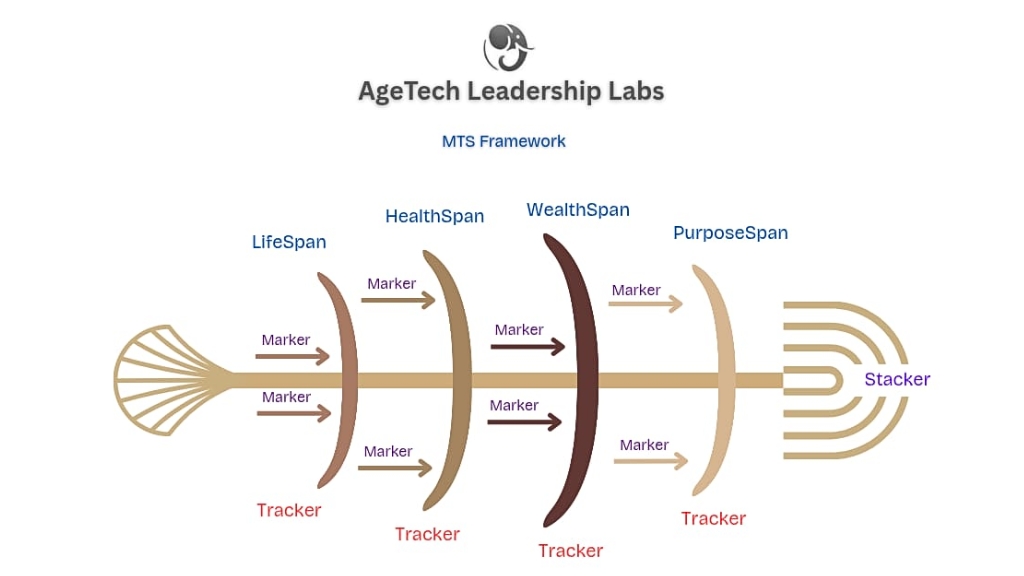
Nitin Jaiswal Founder, AgeTech Leadership Labs In popular discourse, longevity is often reduced to one idea: living longer. As a triumph of science, medicine, and public health, the increase in average life expectancy has been rightly celebrated. Yet, as we enter an era where over a billion people will live beyond the age of 60, we must ask a deeper question: what exactly are we celebrating? Is longevity simply the extension of time? Or must we interrogate its substance, the kind of years we are adding, not just the number? The moment we attach the word “economy” to longevity, the paradigm shifts. We move beyond biology into the realm of systems, behaviours, resources, productivity, infrastructure, and, most critically, outcomes. The Longevity Economy is not just about how long people live, but about how well societies function when they do. As Laura Carstensen, founding director of Stanford’s Centre on Longevity, observes: “Age is a sloppy proxy” for human capability and potential. The opportunity now is to build an economy for a new demographic era, one that measures success not only by the quantity of life but by the quality it sustains. From Years Lived to Years That Matter Lifespan is a statistical fact. But a meaningful life is not guaranteed by a longer one. When longevity becomes both an economic and social reality, its effects ripple across every domain from healthcare and pensions to labour markets and innovation. Yet most frameworks still measure it by the simplest unit: years. We propose a different lens. The value of longevity should be measured not just by duration, but by the nature of those years. This calls for a shift from a single metric to a four-dimensional framework, which we define as the Four Spans of the Longevity Economy: Lifespan: The biological duration of life. Necessary, but insufficient. Healthspan: The number of years lived in good health, free from chronic disease and dependency. Wealthspan: The duration of financial stability, productivity, or economic participation. Purposespan: The span of purpose, mental well-being, and social connection. When these four spans are aligned, longevity becomes an asset. When misaligned, it becomes a paradox where longer life is accompanied by illness, insecurity, and isolation. Why Only Four? The Power of Focused Integration Why just four spans? Why not seventeen, like the SDGs? Because systems thinking demands focus. The Sustainable Development Goals, though well-intentioned, suffered from fragmentation in execution. Their breadth became their weakness. The Longevity Economy requires integration, not dispersion. These four spans reflect the full experience of ageing: Lifespan is the base. Healthspan ensures quality. Wealthspan provides sustainability. Wellnesspan gives meaning. As Lynda Gratton, co-author of The 100-Year Life, puts it: “When you have 100 years to live, you can’t just think about career and retirement. You have to think about multiple careers, multiple relationships, multiple identities. The old linear model is broken.” This four-span framework is simple enough to act on and comprehensive enough to matter. Gen E: The Convergence Generation Enter Gen E: the Emergent, Experienced, and Evolving Generation. They are not exiting relevance, but redefining it. Gen E is not an age bracket. It’s a convergence. As life extends, younger generations will join this new stage, not replace it. Millennials, Gen Z, Gen Alpha they’re all future Gen E. This convergence will reshape policy, business, and culture. Laura Carstensen notes: “A 20-year-old today is more likely to have a living grandmother than a 20-year-old in 1900 was to have a living mother.” Joseph Coughlin of MIT AgeLab puts it best: “The future of ageing is not about the old. It’s about all of us.” The Paradox: Structural Misalignment The Longevity Economy doesn’t suffer from a lack of innovation. It suffers from a lack of alignment. Despite remarkable advances across sectors, efforts remain siloed. This has created a dangerous disconnect across the four spans of later life. Consider this: the global average lifespan is 73.4 years (WHO, 2024), but healthy life expectancy is only 63. That leaves a decade or more marked by illness or disability. Meanwhile, wealthspan begins to shrink in the mid-to-late 50s as retirement looms and income stability declines. The World Economic Forum estimates the global retirement savings gap could hit $400 trillion by 2050. And the span we call PurposeSpan – the span of purpose, mental well-being, and community is rarely planned for, despite research showing that a strong sense of purpose can reduce mortality risk by up to 30% (JAMA, 2019). This is the longevity paradox: progress in one span creates pressure on the others. A longer life can become a burden unless supported by systems that work together. Eric Topol, cardiologist and digital health pioneer, captures it best: “We’re adding years to life, but not life to years. The goal isn’t just longevity, it’s vitality.” Why the Misalignment Exists Because the five core stakeholders of the Longevity Economy – Policymakers, Investors, Innovators, Institutions, and Individuals are not working in sync. Their actions are well-meaning, but fragmented. The result: scattered solutions, limited impact. From Paradox to Perfection: The P2P Framework We propose a new approach: the P2P Framework (Paradox to Perfection). It is a systems-thinking tool to convert the unstable Longevity Triangle into a balanced Longevity Square. This conversion unlocks one of the greatest economic opportunities of our time. But it demands a full rethink, redesign, and rebuild of our physical, digital, social, and institutional infrastructure. The Integration Imperative Across the world, innovators are building siloed solutions: a supplement to fix micronutrient deficiencies, a diagnostics kit for longevity biomarkers, insurance products for older adults, a training course for the silver workforce. Each is a piece. None are the puzzle. “Innovation exists. Integration doesn’t.” That is the core issue. Andrew Scott, co-author of The 100-Year Life, warns: “The institutions we’ve built assume three-stage lives—education, work, retirement—but we’re now living multi-stage lives that require fundamentally different architectures.” The Longevity Economy must move from innovation thinking to infrastructure thinking. The Solution: MTS Infrastructure If the P2P Framework solves the misalignment of spans, the MTS Infrastructure solves

The 8th Continent: A New Economic Territory Defined by Demography
What is 8th Continent? There are 1.5 billion people aged 50 and above living today, and this number is expanding rapidly. We call them Generation E, defined not by the year they were born, but by the years they will live. Unlike previous generations who could expect brief retirements, Gen E faces the reality of potentially 30-50 additional years of life beyond traditional retirement age. The demographic shift is unprecedented. For the first time in human history, people over 50 now outnumber those under 15. By 2035, all major economies will reach a critical turning point, with their working-age populations beginning to shrink while their 50+ populations continue to grow. By 2050, the global population aged 60+ will exceed 2.1 billion people. The Economic Powerhouse Generation E represents an extraordinary economic force. They collectively generate over $17 trillion in annual economic activity. They control $30 trillion in intergenerational wealth transfer and manage $50 trillion in global pension assets. In G20 economies, they account for 70% of disposable income, making them the dominant spending force in the world’s largest markets. To put this in perspective: if Generation E were a country, it would be the third-largest economy in the world, surpassed only by the United States and China. Introducing the 8th Continent A demography and economy of this magnitude can be a continent of its own; we call it the “8th Continent”, a continent defined not by geography, but by demography and economic value. Unlike the seven traditional continents shaped by tectonic forces and bordered by oceans, this eighth continent has been formed by the most powerful demographic force of the 21st century: dramatically extended human lifespans. Yet this massive economic territory remains largely invisible to those who should be serving it. The 8th Continent is systematically ignored by policymakers who design for traditional life stages, overlooked by investors chasing younger demographics, and underserved by innovators focused on other markets. The Integration Crisis The 8th Continent does have innovation, but it lacks integration. Health technologies advance in isolation from financial services. Longevity research progresses without connection to wealth management. Age-tech develops separately from healthcare delivery systems. This fragmentation means that while we’re extending lifespan, we’re not necessarily creating the pleasant, purposeful lives that should accompany those extra years. The current approach concentrates on narrow aspects of the longevity economy – typically healthcare costs or pension shortfalls, rather than recognising the full spectrum of opportunities that longer, healthier lives represent. This siloed thinking will result in longer life, but not necessarily the quality of life we want from those additional decades. What the 8th Continent Requires The 8th Continent needs three fundamental changes: Integration of existing innovations. The breakthrough technologies, financial instruments, and social platforms already exist—they just need to work together rather than operate in isolation. Innovation focused on actual requirements, not trending topics. Instead of building what’s fashionable, we need solutions that address the real challenges and opportunities of extended lifespans. Economic framework, systems, and infrastructure.Like any continent, the 8th Continent needs the institutional architecture to support its population’s needs and ambitions. Building the Architecture AgeTech Leadership Labs – ALL is constructing this foundation. We are defining a Longevity Economy Framework that will help policymakers, investors, and innovators currently operating in silos, achieve alignment around four key lifespans that must work together for successful longevity. We are also building an open-source systems infrastructure called MTS: Markers, Trackers, and Stackers. This platform will provide the operational tools needed to integrate innovations, measure progress, and stack solutions into comprehensive systems that effectively serve the 8th Continent. The 8th Continent is real. Its citizens are here. Its economy is massive and growing. What it needs now is recognition and the infrastructure to reach its full potential. This is just the beginning of a larger conversation about how we build an economy and society designed for longer lives. The architecture of the 8th Continent starts now. Nitin Jaiswal
