From Innovation to Impact: What Singapore’s ACE Report Means for the Longevity Economy
Singapore’s ACE Innovation Trends Report is more than a catalogue of medical technologies; it is a signal that the region is beginning to take the future of ageing and healthcare seriously. By scanning the horizon and highlighting nine areas (which we have compiled into five areas) of breakthrough innovation, ACE has set the stage for how healthcare systems, policymakers, and businesses can prepare for what’s next.
Led by Dr. Fereen Liew , the Agency for Care Effectiveness (ACE) has produced one of the first serious attempts to map technologies that could reshape care in the next five years. Where ACE charts the clinical and technological frontier, AgeTech Leadership Labs (ALL) works on the frameworks that help these advances connect and scale. Read together, they tell a powerful story: innovation is accelerating, but its actual impact depends on how well the pieces are stitched into a coherent whole.
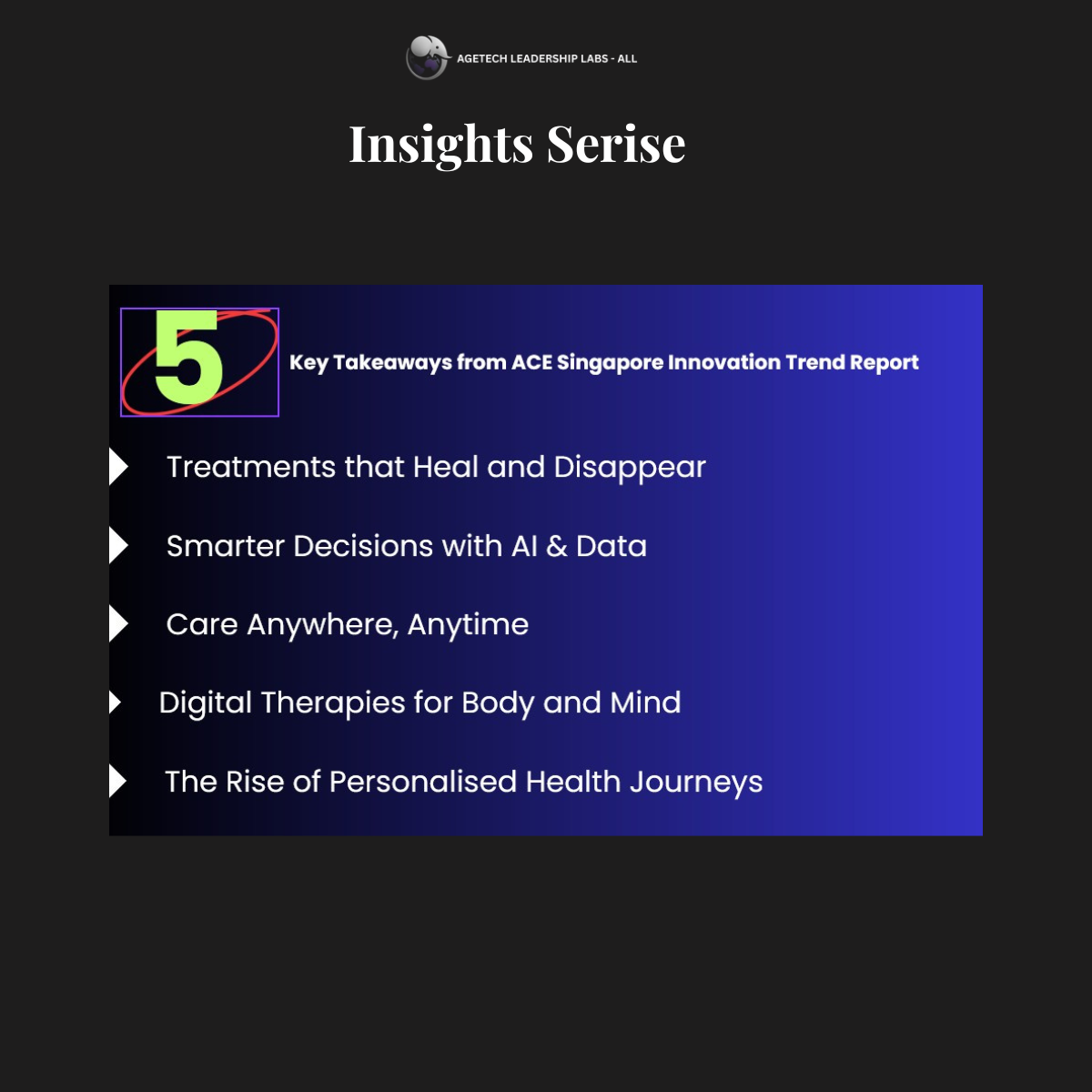
Here are five big takeaways and why they matter for the future of ageing and longevity.
1. Treatments that Heal and Disappear
Imagine an implant that dissolves once it has done its job. Or a surgical procedure that leaves only a pin-sized scar and lets you go home the next day. That is the promise of bioresorbable implants and minimally invasive interventions.
This philosophy is already evident in innovations such as CavaClear ( Philips a system for safe filter retrieval) or smaller, robotics-assisted surgeries. The principle is simple: technology should solve problems without leaving new ones behind.
Every time recovery is faster and follow-up procedures are avoided, patients regain dignity and systems save resources. Less trauma, less burden and more healing.
2. Smarter Decisions with AI & Data
The report highlights how artificial intelligence can assist doctors in diagnosing and treating patients. Pair that with blood-based biomarkers that detect disease earlier and wearables that track health continuously, and a clear theme emerges: healthcare is shifting from a reactive to a proactive approach.
Concrete examples already on ACE’s radar include EchoGo Heart Failure (an AI-supported diagnosis), KidneyIntelX (diabetic kidney disease risk scoring), and Canvas Dx ( Cognoa support for autism diagnosis).
For patients, that means fewer surprises, earlier interventions, and more personalised insights. For systems, it means moving from firefighting illness to anticipating and preventing it. Data, intelligently used, is becoming the new stethoscope.
3. Care Anywhere, Anytime
Not all care needs a hospital bed. With contactless monitoring, sensors can track patients’ vital signs without physical contact. With point-of-care testing, a rapid diagnostic test can deliver lab-quality results at the bedside or in a community clinic.
ACE’s horizon scanning highlights Oxevision, a contactless monitoring system used in mental health wards, as well as rapid diagnostics that are already being piloted in community care.
This shift decentralises healthcare. It makes access quicker, more convenient, and more affordable. In an ageing society, where demand is expected to grow, bringing care closer to people isn’t a luxury; it’s a necessity.
4. Digital Therapies for Body and Mind
What if the treatment for your condition wasn’t a pill, but an app? Digital therapeutics are making that a reality, offering evidence-based programs for the management of chronic diseases or mental health issues. Add virtual and augmented reality into the mix, and rehabilitation becomes interactive, immersive, even game-like.
Examples like Relie VRx ( AppliedVR a VR-based therapy for chronic back pain) demonstrate how software is becoming a form of medicine. This is not science fiction. It is a reimagining of care delivery, where digital tools are as important as drugs or devices.
The potential is especially powerful for older adults, for whom mental resilience and sustained engagement are as important as physical recovery.
5. The Rise of Personalised Health Journeys
The most important theme running through all these trends is personalisation. From wearables that nudge healthier habits to AI tools tailoring treatment plans and apps delivering therapy on demand, healthcare is shifting from one-size-fits-all to what fits me.
This matters because ageing is not a uniform process. Two people at 65 may have vastly different health, wealth, and purpose profiles. Systems that recognise and adapt to that diversity will be the ones that succeed in the Longevity Era.
Why This Matters for the Longevity Economy
If ageing is viewed only through the narrow lens of healthcare, societies will always be reacting to crises. Seen through the lens of the Longevity Economy, however, the opportunity is far greater: building systems that align not just lifespan, but also health, wealth, and purpose.
The ACE Innovation Trends Report is a welcome sign that Singapore and Asia more broadly are beginning to think ahead. The challenge now is to ensure these innovations add up to more than the sum of their parts. That is how we turn the “silver elephant” in the room into one of the most significant economic and social opportunities of our time.
At AgeTech Leadership Labs (ALL), we see ageing not as a burden but as an asset. The task is not simply to add years to life, but to integrate lifespan, healthspan, wealthspan, and purposespan into systems that serve people, families, and societies. That is the essence of the Longevity Economy.
This is why Singapore’s ACE Innovation Trends Report excites us. ACE maps the technologies of tomorrow; ALL works on the frameworks that allow those technologies to connect, scale, and create lasting impact. Together, they point toward a future where innovation in ageing truly redefines longevity.
“The silver elephant is here. Let’s turn it into an opportunity. Follow AgeTech Leadership Labs AgeTech Leadership Labs on LinkedIn and visit the website