Last week, for Trending Tuesday, we looked at the book The 100-Year Life by Lynda Gratton and Andrew Scott, which reshaped global thinking about what it means to live, work, and thrive across a century-long lifespan.
Their central argument was profound yet straightforward: in an age when people routinely live to 90 or 100, the future, as we at AgeTech Leadership Labs define it, will belong to those who can align four essential spans: LifeSpan, HealthSpan, WealthSpan, and PurposeSpan. This alignment isn’t merely a personal aspiration; it is the foundation of the Longevity Economy. It determines whether long life becomes a crisis or a form of compounded opportunity.
The truth is, very few people manage this alignment. Most excel at one or two spans and struggle with the rest. Some build wealth but sacrifice health. Some discover purpose but lose financial resilience. Many live long lives but without meaning or vitality. Yet every once in a while, a single human being becomes a living case study — not because they pursued longevity, but because the way they lived naturally aligned the four spans over time.
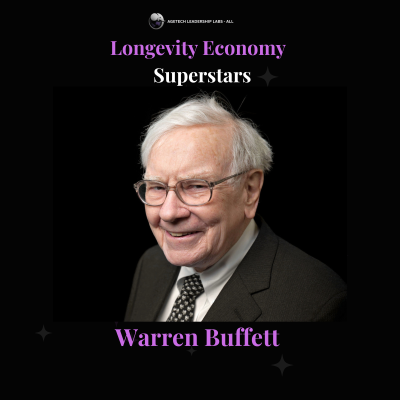
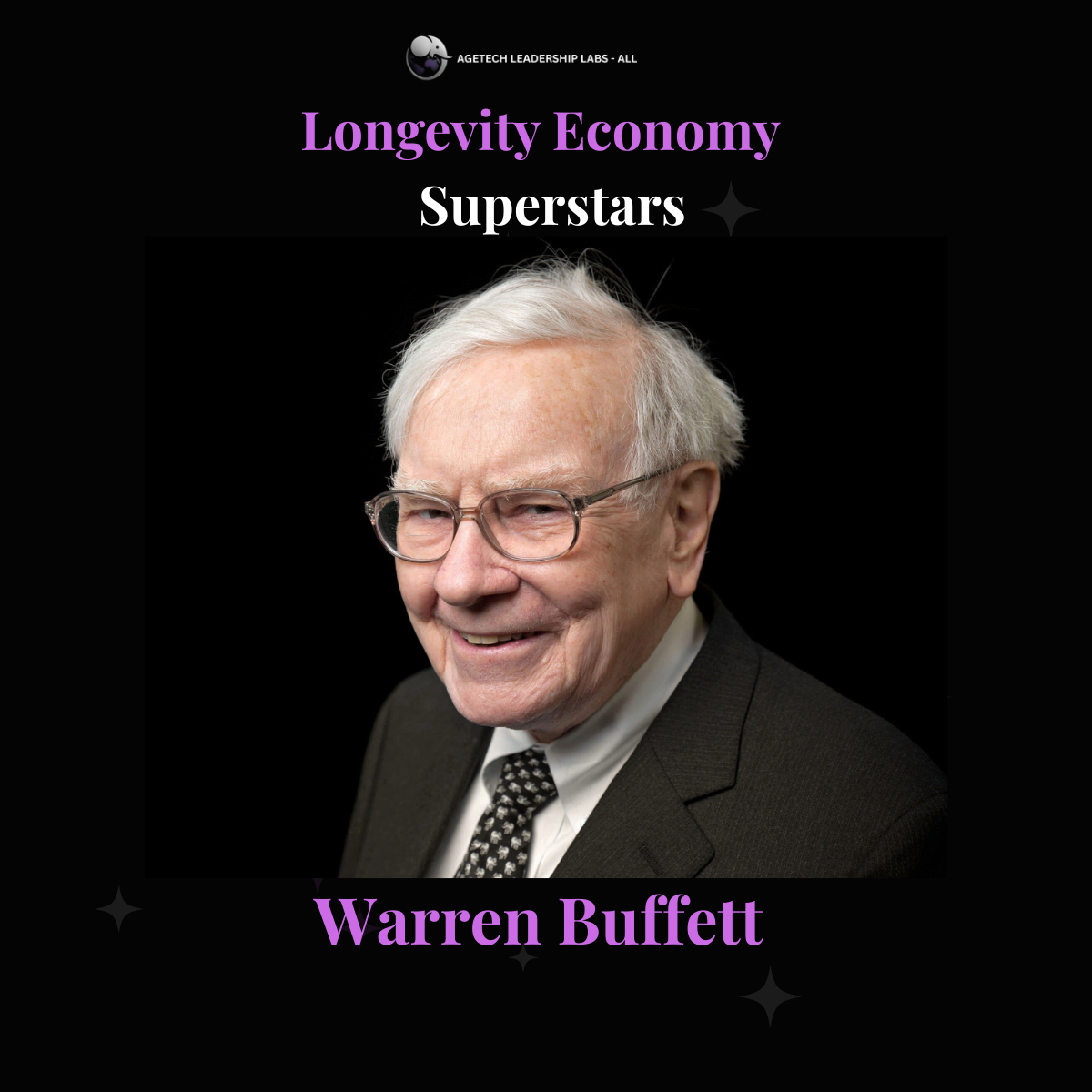
This week, as Warren Buffett steps down from the CEO role at Berkshire Hathaway at the age of 95, we honour him not only as the Oracle of Omaha but as one of the rare individuals who quietly lived the 100-Year Life design long before the concept even had a name. He is ALL Longevity Economy Superstar.
The Unlikely Longevity Blueprint
If longevity were a science experiment, Warren Buffett’s lifestyle would be the control-group failure. The man eats ice cream for breakfast, drinks five cans of Coca-Cola a day, avoids vegetables except mashed potatoes, and orders the same McDonald’s meals with near-religious consistency. He even joked, “I eat like a six-year-old,” and he wasn’t exaggerating.
Yet here he is — 95 years old, mentally sharp, emotionally grounded, and stepping back not because of decline, but because he feels it is time for a younger leadership team to carry the legacy forward.
How does a man who breaks every rule of modern nutrition become a case study in longevity?
The answer, contrary to popular belief, lies not in his diet but in the deeper alignment of his life. Buffett lived with a level of simplicity, emotional stability, and internal clarity that modern researchers now recognise as strong predictors of healthy ageing. He slept eight hours a night. He avoided stress and drama. He nurtured lifelong friendships, especially with Charlie Munger. He read voraciously, stayed curious, and kept his mind in constant motion. His days were calm, not chaotic — a rhythm of reading, thinking, deciding, and teaching.
His happiness came not from consumption but contentment. As he famously said, “The key to happiness is having what you want and wanting what you have.” Genetics may have given him resilience, but it was his aligned way of living that sustained it.
When Wealthspan Becomes Contribution Span
Wealth is the most visible part of Buffett’s story, but it is not the most important. What matters to the Longevity Economy is how he thought about wealth over decades — as a tool for stability, clarity, and contribution. Early in his life, Buffett discovered the transformative force of compounding. He didn’t just understand it mathematically; he understood it philosophically.
“Someone is sitting in the shade today because someone planted a tree a long time ago.” This wasn’t financial advice. It was a worldview.
Buffett built Berkshire Hathaway into a powerhouse by avoiding what destroys compounding — leverage, ego, haste, noise. His philosophy of “never risk what you have and need for what you don’t have and don’t need” became a financial version of longevity thinking: preserve your ability to stay in the game.
Even in his most recent shareholder letter, he reminded investors: “The great majority of your money remains in equities… Our preference for productive assets will not change.”This is long-term Wealthspan thinking — designing financial life so it survives 50 or 60 years with dignity and security.
What makes Buffett exceptional is that he didn’t stop at personal Wealthspan. He evolved it into a Contribution Span. Through the Giving Pledge and over $60 billion in donations, he turned his long-term compounding into long-term impact — supporting vaccines, education, and poverty alleviation around the world.
Purposespan: The Engine That Keeps You Young
If wealth gave Buffett stability, purpose gave him vitality. The man genuinely loved his work. He didn’t perform the role of investor; he lived it. His days were filled with reading, thinking, and making rational decisions — activities that strengthened the brain rather than drained it.
He often described it: “I get to tap-dance to work every day.”
Purpose wasn’t a separate compartment of his life. It was the core operating system. Even as one of the wealthiest men alive, he didn’t drift into boredom or excess. He stayed grounded through routine, meaning, and love for the game. His partnership with Charlie Munger was a four-decade masterclass in shared purpose — two men thinking, debating, learning, and teaching together.
He also shared a more profound truth: “You don’t get rich by what you earn; you get rich by what you avoid.” Avoiding envy, avoiding noise, avoiding clutter — avoiding the emotional and cognitive toxins that age us from the inside out.
His purpose kept him relevant. Purpose kept him mentally young. Purpose kept him compounding through every decade of his life.
The Lightness of Living
There is a hidden philosophy running through Warren Buffett’s life — a philosophy of lightness. While many accumulate more as they age — more houses, more possessions, more status symbols — Buffett aged through liberation.
- He lived in the same house he bought in 1958.
- He drove himself.
- He kept a small team.
- He maintained a simple daily structure.
He once said, “The best investment you can make is in yourself.”
Notice that he didn’t say in things.
This is a crucial longevity lesson:
– Heavy lives age faster.
– Lighter lives age better.
Big houses with empty rooms, possessions rarely used, calendars filled with obligation rather than meaning — these are the hidden weights that make longevity feel exhausting rather than expansive. Buffett understood this intuitively. He removed unnecessary burden and replaced it with clarity, freedom, and focus.
The Four-Span Life: Buffett as the Blueprint of Alignment
When Andrew Scott wrote that the future belongs to those who can “reconfigure time,” he was describing a world where life becomes a multi-stage journey rather than a linear one. Warren Buffett lived this truth long before it was fashionable.
Here’s how his four spans aligned almost perfectly:
- Lifespan — He stayed alive long enough to fully experience the compounding effects of relationships, reputation, and wisdom.
- Healthspan — He protected cognitive health through curiosity, friendships, calm living, and low drama.
- Wealthspan — He allowed time to multiply value and avoided every decision that could take him out of the game.
- Purposespan — He never retired from meaning. He evolved from building Berkshire to guiding Berkshire and giving his wealth away.
This alignment — calm, consistent, cumulative — is the rarest achievement of the modern age.
A Moment to Pause
As Warren Buffett steps down, the world is not merely watching a corporate transition. It is witnessing the closing chapters of one of the most aligned lives of the 20th and 21st centuries. Buffett shows us that the 100-Year Life does not require perfection — only coherence. It requires designing life so that the four spans reinforce each other rather than collide.
Warren Buffett didn’t chase longevity.
Longevity chased him.
And that is why he is our Sunday Longevity Superstar — not just this week, but perhaps for an entire generation entering the age of longer lives.