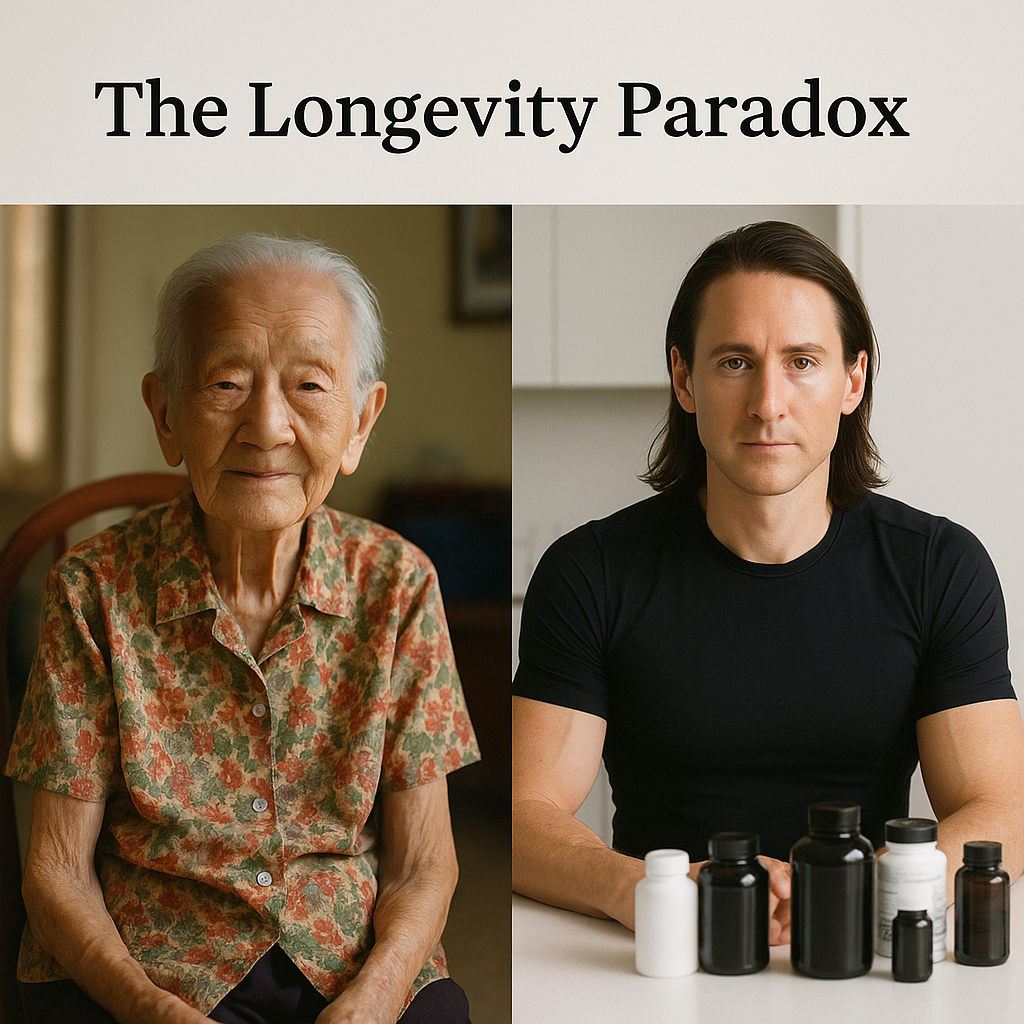
Channel NewsAsia recently profiled Madam Lim, a 105-year-old Singaporean who is still living medicine-free. Born in 1920 and married at 18, she has lived through a century of wars, independence, industrialization, and digital transformation — yet she has never relied on medication. Her story is extraordinary not only for her age, but for what it represents: the possibility of living long through simplicity, family, and purpose.
Contrast this with Bryan Johnson, the 47-year-old Silicon Valley entrepreneur who spends US$2 million a year on his anti-aging program, Blueprint. He consumes more than 90 supplements daily, follows a tightly measured plant-based diet, and undergoes constant medical testing in pursuit of reversing his biological age. His life is optimized, quantified, and engineered, a living experiment in bending the arc of human aging.
Two lives. Two extremes. One paradox.
Lessons from Two Paths
- The natural question is: Which approach is best?
- The truth is, it’s not either/or. Both offer important lessons.
From Madam Lim:
Lifestyle and food choices are the foundation. The world’s “blue zones” places such as Okinawa in Japan, Sardinia in Italy, or Nicoya in Costa Rica, consistently show that people live longer, healthier lives when they eat simple, plant-forward diets, move naturally throughout the day, and stay embedded in strong family and community networks. Madam Lim’s story echoes these findings. She is living proof that resilience can be built through rhythm, connection, and moderation.
From Bryan Johnson:
Healthcare and interventions are the safety net. When life throws curveballs – cancer, accidents, or genetic vulnerabilities, medicine and science are indispensable. We should celebrate the possibilities that science brings, from gene therapies to regenerative medicine. But Johnson’s story also raises an important caution: these tools should support how we live, not become the default way to live.
The Johnson Factor:
It would be unfair to dismiss Johnson’s efforts as vanity or indulgence. His discipline and willingness to turn his body into a laboratory have pushed the global conversation on human longevity further than most researchers or policymakers. He has sparked debates about whether we should measure biological age, whether protocols can be standardized, and how much aging is preventable.
But his approach comes with two unavoidable challenges:
- Proof: The long-term effectiveness of Blueprint is still unproven. Extending healthspan or reversing biological age cannot be confirmed by short-term metrics. It requires decades of evidence.
- Cost: At $2M a year, Johnson’s regimen risks being a rich man’s privilege. Even if his methods work, they are inaccessible to 99.9% of humanity.
And there is a deeper concern. A future where health depends on endless pills, tests, and interventions feels fragile. It risks making life itself dependent on external systems — laboratories, supplements, and technologies, rather than inner resilience and social support. Longevity cannot be built only on what money can buy. It has to be grounded in how we live: food, family, purpose, and community, with science as a safety net rather than a substitute.
The Blindspot in Longevity
Both Lim and Johnson focus on lifespan (the number of years lived) and healthspan (the number of years lived in good health). These are important, but they are not sufficient.
Longevity must also account for two often overlooked spans:
- Wealthspan: ensuring financial security across longer lives. What happens when people live to 100, but their retirement savings run out at 80? Without financial systems that adapt to longer lifespans, extended years may mean decades of anxiety and poverty.
- Purposespan: ensuring that longer lives remain meaningful and connected. Without purpose, longer life can devolve into isolation and irrelevance. Madam Lim’s story reminds us that community, family, and rhythm provide the scaffolding that sustains life beyond the biological.
If wealthspan and purposespan are ignored, then longevity risks becoming a crisis rather than a promise, more years, but lived in stress, disconnection, and imbalance.
The Real Challenge
The Longevity Paradox is not about choosing between Madam Lim’s simplicity or Bryan Johnson’s science. It is about weaving the best of both into a balanced framework.
Madam Lim shows us that foundations matter: lifestyle, food, family, and purpose remain the cornerstones of long life. Johnson shows us that ambition matters: science may one day push the limits of what is possible, offering interventions that prevent or repair the damage of aging.
But the real challenge lies in shifting our focus. We must stop obsessing only over lifespan and healthspan, and begin investing just as much energy, innovation, and policy into wealthspan and purposespan. Because if those two dimensions are neglected, longer lives will not necessarily be better lives.
From Paradox to Promise
Longevity should not mean simply extending the human timeline. It should mean expanding the quality of those years across health, wealth, and purpose.
Madam Lim whispers to us from the past: simplicity, resilience, and connection carry enormous power. Bryan Johnson shouts to us from the future: science may one day give us the tools to live far longer than we thought possible.
The real breakthrough will come not from choosing one path or the other, but from building systems that align all four spans – lifespan, healthspan, wealthspan, and purposespan.
Only then will longevity move from paradox to promise, not just longer lives, but better ones.
Nitin Jaiswal – Longevity Economy