If you’re 50 in 2025, you are part of Gen E, a term defined by AgeTech Leadership Labs (ALL) to describe everyone over 50, the generation of experience, energy, and encore. Unlike past cohorts who saw 50 as the beginning of decline, Gen E is living in an era where technology and longevity are rewriting the script. For Gen E, the next chapter isn’t about winding down. It’s about gearing up.
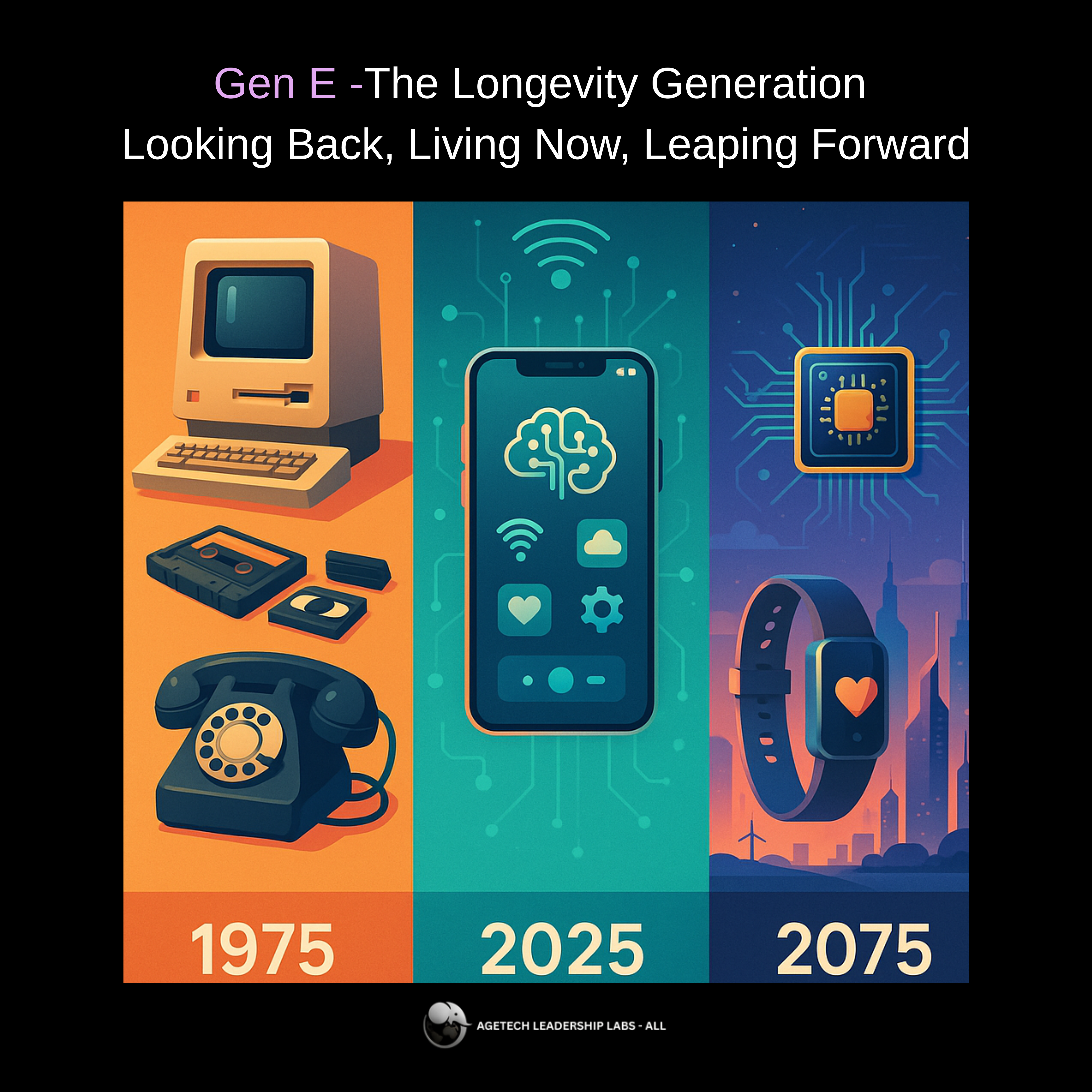
1975 vs 2025: The Contrast That Defines You
Born in 1975, you arrived at a time when technology was still a sideshow. Microsoft had just been founded. The Altair 8800, a box of blinking lights, was being hailed as the “first personal computer,” though it was mostly for hobbyists. The internet existed, but only as ARPANET, connecting a handful of universities and defense labs. Phones were tethered to walls. Music lived on vinyl and cassette tapes. If you wanted information, you pulled an encyclopedia off the shelf.
The corporate world reflected this too. On the Dow Jones index, the giants were industrial titans and manufacturers. IBM was the tech standout, but it was an exception in a sea of oil, steel, and consumer goods firms.
Now fast forward to 2025. The world you live in is unrecognizable from the one you were born into. Every person carries a supercomputer in their pocket. Artificial intelligence can generate business strategies, write code, and compose music. Work, shopping, and entertainment have all moved online. The Dow Jones itself tells the story: tech companies dominate, and Nvidia the AI chipmaker recently replaced Intel on the index, symbolizing how computing power now drives global markets.
Gen E is the bridge between these two realities: you’ve lived the leap from analog scarcity to digital abundance.
What’s Next? The Next 50 Years for Gen E
If the last 50 years took us from the Altair to AI, what will the next 50 hold for Gen E? Two forces stand out as today’s “internet-in-1975” moments — just emerging, still confined to labs and big institutions, but destined to spill into everyday life: quantum computing and preventive medicine.
Quantum Computing: Today’s Internet Moment
Think of the internet in 1975 hidden in military labs, unthinkable as a household utility. That’s where quantum computing is today.
- Take finance: HSBC, working with IBM, recently completed a quantum trial that boosted bond-trade prediction accuracy by 34%. JPMorgan, Goldman Sachs, and others are investing heavily in quantum research to crack problems classical computing can’t.
- Google has demonstrated its “Sycamore” processor solving problems beyond today’s supercomputers.
- Pharma companies are testing quantum simulations to design molecules faster than ever before.
Right now, this is the domain of banks, labs, and governments. But so was the internet in 1975. If history repeats, quantum will shrink, commercialize, and democratize. One day, your personal AI assistant may use quantum to optimize your health plan, financial portfolio, or travel schedule in seconds just as casually as you search on Google today.
Preventive Medicine: Living Health Before Illness
The other frontier is health. In 1975, you only knew you were sick when you felt sick. In 2025, your smartwatch tells you days before your body does. Preventive medicine is moving from catchphrase to practice:
- AI can now detect early signs of diabetes or dementia from eye scans.
- Blood tests that catch cancers years before symptoms are emerging.
- Wearables continuously monitor heart health, sleep, and stress, nudging you toward healthier choices.
The shift is profound: from treating illness to preventing it. For Gen E, this means that turning 50 today may not be the midpoint of decline but the starting line of decades of extended healthspan.
By 2075, illness itself could become optional detected, predicted, and reversed before it ever interrupts your life.
The Gen E Advantage

Gen E isn’t just watching the future, you are the future. You’ve already lived through five decades of disruption: rotary phones to smartphones, cassette tapes to Spotify, encyclopedias to Wikipedia to AI copilots. That adaptability is your superpower.
In 1975, your parents at 50 were slowing down. In 2025, you at 50 are gearing up. And with quantum and preventive health, your next 30–50 years could be your most productive yet.
Gen E is Generation Encore, Not Generation Exit!
Gen E defined by AgeTech Leadership Labs will not just experience it. You will live it, lead it, and leverage it.
If you’re 50 in 2025, here’s the truth: the first half was rehearsal. The Encore starts now.
Nitin Jaiswal
#Gen #LongevityEconom #Longevity #FutureOfAging #QuantumComputing #PreventiveHealth #AgeTech #Healthspan #Wealthspan #Innovation #NitinJaiswal #AgeTechLeadershipLabs