Earlier this week, in our Markers Monday post, we explored the rise of the epigenetic clock, the invisible timer written in our DNA that tells us how fast or slow our bodies are truly ageing.
But that clock is only the beginning. Around it, an entire industry is emerging, one racing to measure, interpret, and even reset biological time. From molecular diagnostics to circadian wearables, these innovators are redefining what it means to live not just longer, but in rhythm with life itself.
Welcome to the new frontier of longevity, the Biological Clock Economy, where startups, scientists, and investors are learning to turn time itself into technology.
At AgeTech Leadership Labs (ALL), we study how individual markers, like the epigenetic clock, evolve into system-level changes and how data about our cells and rhythms can reshape health systems, economies, and daily life. The biological clock isn’t just a discovery in genomics; it’s a signal that the Longevity Economy is entering its next phase: measurable time.
Why “Body Clocks” Matter More Than Ever
We usually think of time as something to fight wrinkles, ageing, and the relentless tick of birthdays. But science now suggests the real race is to work with time, not against it.
Every cell in our body has its own tiny clock that helps guide sleep, healing, and energy. As Nobel laureate Jeffrey C. Hall observed, “Circadian rhythms are the fundamental language of life; every organism listens to its own clock.” When these inner clocks fall out of sync through late nights, stress, or constant screen time, health problems soon follow, from fatigue to metabolic disease. Today, a new group of scientists and startups is finding clever ways to help us read and even reset these body clocks using wearable technology and artificial intelligence.
From Counting Steps to Timing Health
The first fitness trackers taught us to count: steps, calories, and sleep hours. Now, the latest tech asks a deeper question — when should you act for the best results? “Technology will be the tuning fork of the modern circadian era,” says Dr Satchidananda Panda of the Salk Institute. His research shows that when we eat, sleep, or exercise, these activities can influence health outcomes as much as how much we do. Startups are now translating those insights into technology that tracks temporal biomarkers — data revealing not just how well we function, but when our bodies perform best.
- Eating breakfast at sunrise
- Exercising when your body is “ready”
- Avoiding late-night screen use
All can make a difference, studies show. Startups are helping by tracking not just our activities, but also when our bodies do well or struggle.
Who’s Leading This “Time Tech” Revolution?
As Panda notes, “Technology will be the tuning fork of the modern circadian era.” And that’s exactly what the emerging “Time Tech” industry is beginning to build.
Molecular Clock Pioneers:
- Altos Labs (US/UK): Works on turning back the clock in ageing cells, literally making them “younger.”
- TruDiagnostic: Using DNA tests to show your biological age vs. your calendar age.
Wearable Rhythm Trackers:
- Oura Ring (Finland/US): Measures sleep and body temperature, helping you fix poor sleep habits.
- WHOOP: Used by athletes to schedule recovery at their peak times.
- Eight Sleep, TimeShifter, Supersapiens: Use sensors and apps to guide your sleep, meals, and even travel recovery.
Longevity Platforms:
- InsideTracker & Chronomics: Pull together multiple “clock” signals from blood, DNA, and lifestyle to recommend what’s best for you.
- Novos Labs & Tally Health: Build personalised age-management plans.
- Ega Labs: Ayurvereda-based Longevity Alignment platform
These companies are helping people answer not just “How healthy am I?” but “What’s the best time for me to be healthy?”
Real-World Impact: How Time Tech Touches Lives
Imagine waking up and having an app tell you when your body is primed for a productive morning, or receiving a gentle reminder that tonight’s late dinner will impact tomorrow’s energy based on your own sleep and hormone rhythms. This isn’t science fiction: thousands of people using devices like the Oura Ring or Eight Sleep mattress already experience better sleep and recovery by tuning into their personal circadian data.
For working professionals, fatigue-management platforms like WHOOP make a difference in industries where timing is life-or-death—pilots, nurses, and emergency teams rely on these insights to stay alert. One European airline cut crew fatigue by 20% by rescheduling shifts according to chronotypes, proving the tech’s power.
Entrepreneurs and health-driven families use InsideTracker to plan nutrition and workouts aligned with unique rhythms, moving beyond one-size-fits-all guidance.
Globally, countries such as Japan and Nordic nations explore national “circadian alignment,” redesigning school start times and public transportation schedules. Early results show fewer sick days and improved school performance, highlighting a future where society moves in better rhythm.
Why This Matters For You and Society
– Better health, less stress: Knowing your “chrono-profile” lets you plan meals, sleep, and work when your body is naturally strongest.
– Smarter workplaces: Shift scheduling and office lighting are already adapting to circadian science, boosting alertness and mood.
– Economic benefits: Countries investing in rhythm-aligned infrastructure see reductions in chronic disease costs and higher productivity.
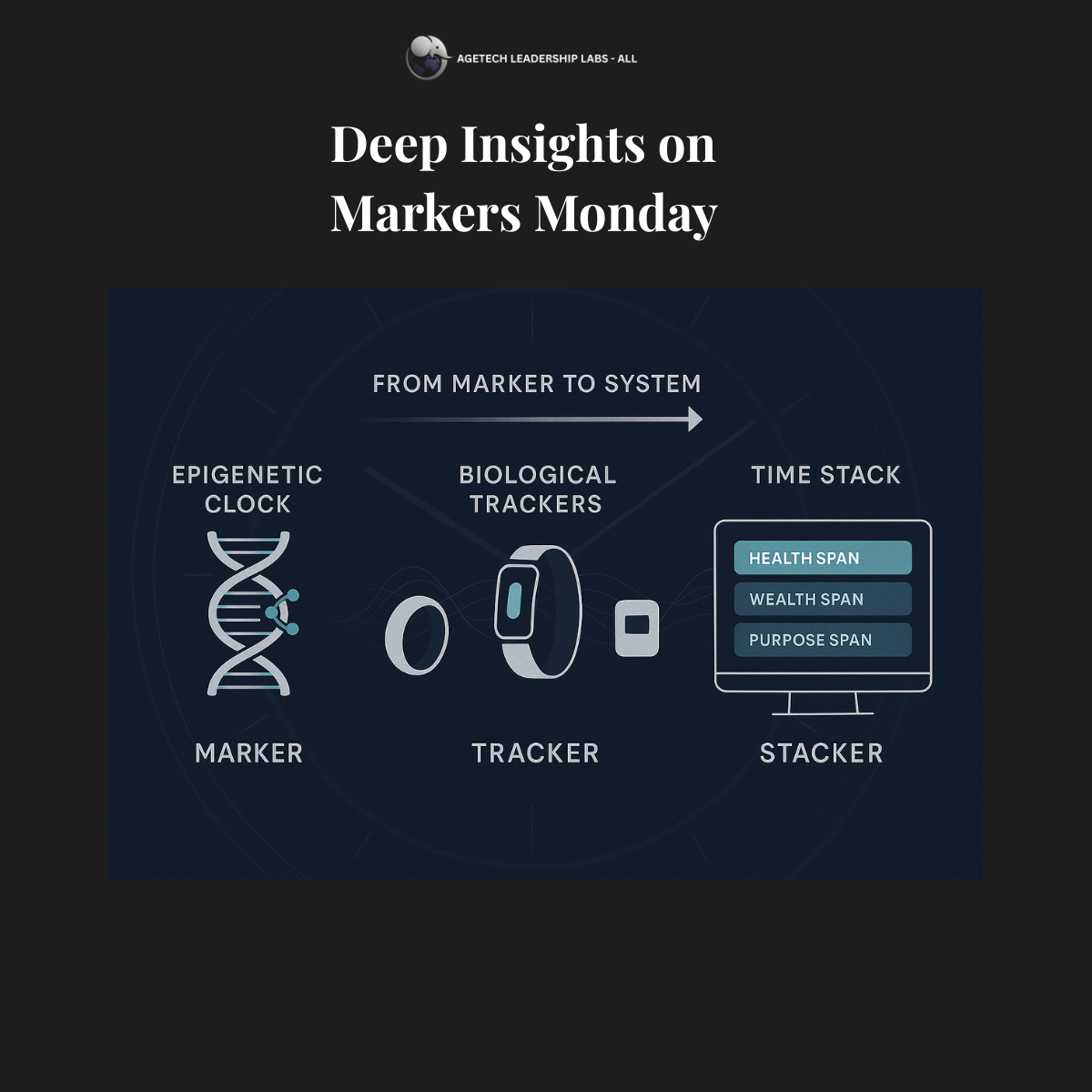
The Pattern: From Markers to Trackers to Stackers
Scientists and startups track biological time at three layers: cell-level “markers” (like DNA signals), wearable “trackers” measuring daily rhythms, and “stackers” that integrate these data to give personalised advice. This layered approach turns fragmented health data into a living map of lifespan, healthspan, and wellbeing.
The Integration Imperative
Each of these breakthroughs, whether decoding DNA clocks or optimising sleep cycles, solves one part of the puzzle. But the future of the Longevity Economy depends on how these fragments connect. That’s where frameworks like the Markers–Trackers–Stackers (MTS) model from AgeTech Leadership Labs come in: building the infrastructure that aligns biological time with economic and societal systems. ALL’s work focuses on translating cutting-edge science into scalable policy, investment, and innovation standards so that the race to reset time benefits not just individuals but entire populations.
Investment Momentum and Ethical Questions
Venture capital in biological-age startups doubled to over $6 billion in 2024. The next health asset class is “time-based wellness”, covering sleep tech, circadian lighting, and metabolic monitoring. Yet, rewinding time raises ethical questions: Who gets access? Will biological age affect insurance or jobs? Can we redefine what “on time” and “purpose” mean in a changing lifespan?
The work of AgeTech Leadership Labs sits at this intersection, turning science into systems and markers into movements, helping nations and industries navigate the coming “Time Economy.”
In Conclusion
We once measured life by birthdays. Soon we’ll measure it by balance. Startups decoding the biological clock aren’t just building gadgets; they’re building a new relationship with time, where health is rhythm, not resistance.
Tags:
#LongevityEconomy #AgeTech #Chronobiology #HealthTech #FourSpansFriday #BiologicalAge #Wealthspan #PurposeSpan