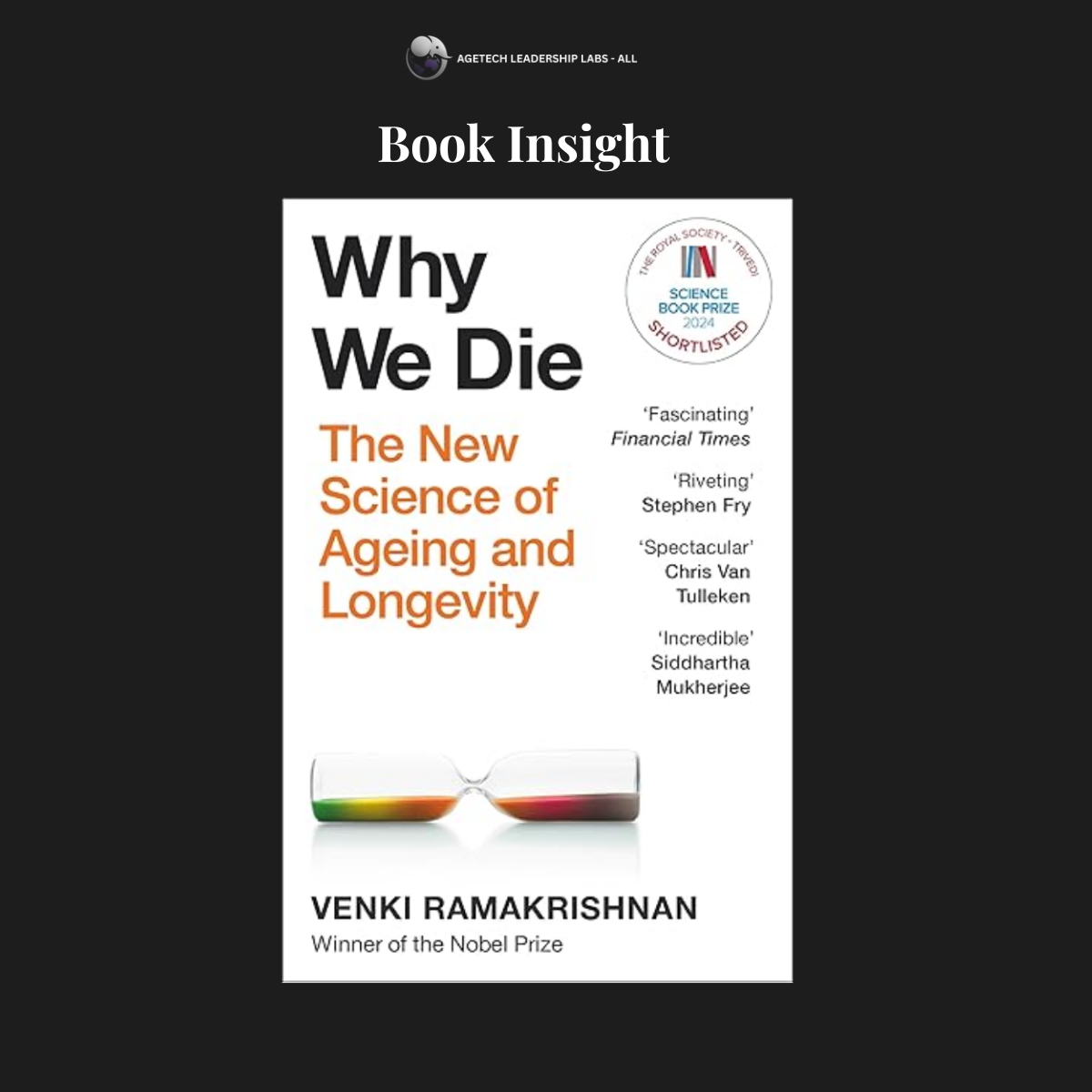
In this Book Insight from AgeTech Leadership Labs, Nitin Jaiswal explores Venki Ramakrishnan’s The Longevity Divide, examining what it reveals about the evolving Longevity Economy — and why, as science bends time, society must ensure it doesn’t break apart.
“The dream of ending ageing could easily turn into a nightmare of new inequality ”- Venki Ramakrishnan, Why We Die
What if humanity’s greatest scientific triumph – the power to slow or even reverse ageing becomes its most dangerous divide? A new inequality is emerging, measured not in wealth or privilege, but in years of life itself.
The Age of the Ageless
Scientific advances suggest ageing results from a gradual loss of biological “information.” Harvard geneticist David Sinclair describes this as the body’s equivalent of data corruption – errors that, in theory, can be repaired. His research shows how small, consistent interventions compound over time, multiplying our capacity to live longer, healthier lives.
Yet, as Nobel laureate Venki Ramakrishnan asks, who will have access to these breakthroughs if they truly extend life? He warns that if advanced longevity tools remain within reach of only the wealthy, the lifespan and healthspan gaps will grow even wider. The rich already live decades longer than the poor; new technologies could turn that advantage into permanence. This is his idea of Longevity Divide.
Time as the Ultimate Commodity
Today, billionaires are investing heavily to buy time. Jeff Bezos funds Altos Labs; Google’s Calico dreams of ending death; biohacker Bryan Johnson spends millions a year attempting to reverse his biological age.
Meanwhile, one billion people still lack access to basic healthcare. In the United States, men in the top 1 percent of income live nearly 15 years longer than those in the bottom 1 percent; in the U.K., the gap between rich and poor neighbourhoods exceeds eight years. The World Health Organization finds that inequities in income, environment, and access to care shorten lives far more than genetics ever could.
Longevity, then, is not just a story of biology, it’s a story of economics and justice.
The Next Great Divide : The Longevity Divide
Historian Yuval Noah Harari foresaw a “race between castes of mortality.” That race is underway. Technology always diffuses unevenly: a vaccine delayed by ten years costs lives; a longevity therapy delayed by ten years costs lifetimes. The result could be a two-speed humanity, one cohort living beyond 120, another still battling preventable disease before 70. Globally, the gap between LifeSpan and HealthSpan – the years lived in good health has widened to nearly a decade. Science is adding years to life even as inequality subtracts life from those years.
The Economics of Extra Years
Longevity is macroeconomics with mitochondria. The World Economic Forum values the longevity economy at about $17 trillion annually, reshaping labour, finance, and healthcare. Longer lives could boost productivity and innovation if health gains are broadly shared. If not, time itself becomes a compounding asset. Wealth buys better care, producing more years to accumulate wealth — a feedback loop the WHO calls the social gradient of health. As Ramakrishnan notes, “How long you live may soon depend less on biology than on budget.”
Bridging the Gap: The AAA North Star
As Nitin Jaiswal notes in his work on the Longevity Economy, inequality grows when access to healthspan innovation is uneven. The question now is not who will live longer but who decides who gets to. Science alone can’t answer that; policy must.
At AgeTech Leadership Labs, the guiding principle is the AAA North Star: making longevity Available, Affordable, and Accessible.
- Available: Breakthroughs must move beyond elite clinics into public health systems, as vaccines once did.
- Affordable: Markets won’t close cost gaps fast enough; public–private partnerships and open R&D can.
- Accessible: Tools must work across ages, languages, and digital literacy levels, because exclusion often hides in the interface, not the molecule.
The AAA framework links scientific progress to social inclusion, turning discovery into shared opportunity rather than private privilege.The Longevity Divide must be addressed before it becomes a deep valley difficult to navigate.
From Vision to Infrastructure
Science alone won’t deliver equitable longevity without systems that sustain it. Nations need longevity infrastructure data networks, preventive-care ecosystems, and age-inclusive workforce policies that treat ageing as an opportunity, not a burden.
Stanford psychologist Laura Carstensen, author of A Long Bright Future, reminds us that most gains in life expectancy came not from miracle drugs but from sanitation, nutrition, and education. The WHO estimates that closing global health inequities could save millions of lives each year and extend life expectancy in low-income countries by decades.
Regulators can accelerate progress by classifying ageing as a treatable condition a step already under debate in the European Parliament. Otherwise, societies may become, in Ramakrishnan’s words, “longer-lived but not better lived.”
A Compass for a Longer Century
Every technological revolution faces a choice: inclusivity or entrenchment. Longevity science is no different.
The AAA North Star offers a pragmatic compass to keep time a public good, not a private asset. If breakthroughs are available across borders, affordable across incomes, and accessible across generations, the gift of longer life can spark a shared renaissance. Otherwise, privilege becomes embedded in biology itself.
As economist Andrew J. Scott writes, “More time is our most valuable resource. The question is what we do with it and who gets enough of it to choose.”
The 20th century gave humanity universal education, electricity, and vaccines. The 21st must do the same for extra years of life. Progress should not be measured by who lives longest, but by how many live well, longer.
At AgeTech Leadership Labs, Nitin Jaiswal continues to shape the Longevity Economy dialogue for a more inclusive future