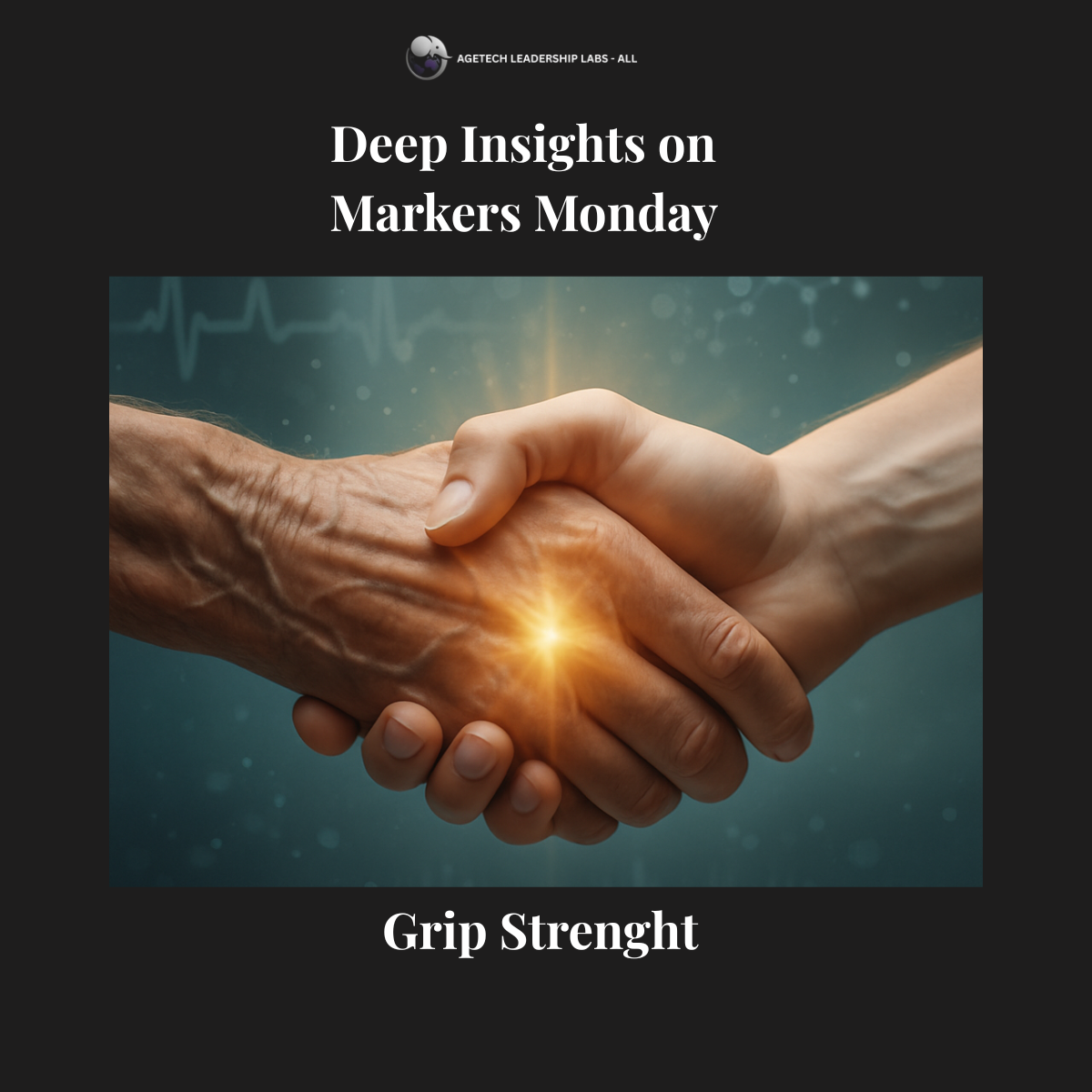
Last week at MarkersMonday, we introduced Grip Strength as a vital marker from the HealthSpan domain, a simple yet powerful predictor of how well we age.
This week, we go deeper into the science, economics, and intelligence behind this humble yet revealing measure, and explore how it connects to the broader Longevity Economy through the MTS Framework (Markers, Trackers, Stackers) developed by AgeTech Leadership Labs
When longevity becomes the new normal, measurement becomes the new medicine.
Among all health metrics, Grip Strength stands out as one of the most robust predictors of biological age, independence, and survival.
Scientific Foundations: Grip Strength as a Biomarker
Grip strength is measured with a hand dynamometer, which captures the maximum force of the hand muscles in kilograms or pounds.
It reflects not only muscular power, but also neurological integrity, cardiovascular efficiency, and metabolic health a whole-body indicator rather than a localized test.
Research since the 1980s has consistently validated grip strength as a clinical biomarker of ageing and mortality:
- A 2018 meta-analysis in The Lancet (Leong et al.) of 140,000 participants across 17 countries found that every 5-kg drop in grip strength correlated with a 16–20% higher risk of premature death, independent of smoking, blood pressure, and BMI.
- Additional studies have linked lower grip strength to higher risk of heart disease, cognitive decline, mobility limitations, and hospitalizations sometimes with greater predictive accuracy than cholesterol or blood pressure.
- Grip strength typically peaks at ages 35–40 and then declines gradually, with an annual reduction of 1–2% after 60, influenced by diet, physical activity, and chronic disease.
Real-World Applications and Economic Impact
At a population level, grip strength is emerging as a macroeconomic variable—a marker that connects physical capacity with national productivity.
- Japan integrates grip testing in elder care to track functional ageing and reduce long-term dependency.
- European insurers (Germany, Netherlands) use grip data to design incentive-based wellness premiums.
- In Singapore, modeling by geriatric economists suggests that a 10% improvement in average grip strength among adults aged 60+ could cut national healthcare costs by 1.2% of GDP annually, through reduced hospitalization and delayed frailty.
- In the U.S., frailty-related healthcare costs exceed $50 billion per year, with grip strength now widely recognized as a top predictive variable for functional decline.
Grip strength, in short, has evolved from a gym test into an economic indicator, one that quantifies the strength of nations as much as individuals. The evidence is clear: grip strength is no longer just a physical measure it’s a health system signal.
The MTS Framework: Turning Markers into Meaning
To manage what we measure, we must connect what we collect. That’s the mission of the #MTS Framework — Markers, Trackers, Stackers, developed by AgeTech Leadership Labs as the intelligence infrastructure for the Longevity Economy.
MTS transforms scattered data from medical systems, fitness devices, and financial trackers into an integrated operating system that links health, wealth, and purpose.
Here’s how Grip Strength fits into the model:
Marker – Defining What to Measure
Grip strength serves as the Marker, with normative healthy ranges of 35–60 kg for men and 20–40 kg for women, adjusted by age and ethnicity.
The insight lies in the trajectory—is your grip getting weaker, holding steady, or improving with interventions?
Tracker – Measuring the Reality
The Tracker captures data over time.
Traditional dynamo meters provide snapshot readings, while new wearable sensors and smart grips record micro-changes in strength during daily activity.
Linking this data with lifestyle metrics—sleep, nutrition, stress, and exercise—turns static readings into living feedback loops.
Stacker – Connecting the Ripple Effects
The Stacker layer reveals how one marker influences others across the four spans of longevity:
- Lifespan: Low grip strength correlates with all-cause mortality.
- Healthspan: Decline precedes frailty, mobility loss, and metabolic inefficiency.
- Wealthspan: Weaker grip predicts early workforce exit, higher care costs, and dependency.
- Purposespan: Physical capability supports confidence, caregiving, and social engagement.
Grip strength, in this model, is the keystone marker—strengthen it, and you fortify the system that sustains life, livelihood, and meaning.
From Data to Design: Personalized Longevity Networks
In an MTS-enabled ecosystem, users could click on “Grip Strength” and instantly view:
- Their personal trend line
- How it compares to age-based benchmarks
- Services, trainers, or digital tools to improve it
- Ripple effects on other spans (e.g., improved mobility → higher work participation → greater wellbeing)
Artificial intelligence then learns from these interactions modeling how changes in one marker influence others.
This creates a dynamic longevity network, where data doesn’t just inform but adapts and guides.
This is the next frontier: from health tracking to health orchestration a shift from reactive medicine to proactive lifespan design.
Conclusion: Grip Strength as a Keystone of Longevity Intelligence
Grip Strength transcends its physical dimension. It is a sentinel of systemic ageing, a predictor of independence, and a bridge between biology and economy.
When powered by the MTS Framework, it becomes more than a number it becomes a signal for how well individuals, institutions, and nations are preparing for the age of longevity.
“What we hold in our hands is more than strength—it is the power to hold our future steady.”