

In Hyderabad, along with Kiran Vadlamani, I had the privilege of meeting Dr. K. Ravindranath a visionary who embodies what I call Gen E: leaders who’ve created impact in their prime and are now writing their Encore — a new chapter of impact, not a repeat of the old one. We all know Hyderabad as India’s Pharma Capital and the GCC Capital of the region. But what struck me during this visit is how it’s also becoming the HealthTech Start-up hub of India. And it’s thanks to pioneers like Dr. Ravindranath who are fueling this transformation. As the founder of Global Hospitals, he built one of India’s leading multi-organ transplant networks, later acquired by Gleneagles, putting Hyderabad on the global map for quaternary care. In his Encore: Dr. Ravindranath has chosen not to replicate past success — but to reinvent impact. From his pledge of 70% of his wealth to create a world-class HealthTech University & Innovation Hub, to backing start-ups through Global Health X (GHX), he is shaping the next wave of health innovation. What impressed me most is that many of the ventures in his portfolio are not just building apps, but physical products, infrastructure, and services, the kind of deep, long-horizon innovation that transforms healthcare delivery. This is Gen-E, Encore in Action: Leaders who don’t just stop after success, they write an Encore chapter that is bigger than their first act. If more of Gen E steps into this role, India won’t just be known for making medicines. We will be known as the place where the future of health innovation is built. Some of the ventures Dr. Ravindranath and his team lead by Satish Kottapalli, is backing through Global Health X (GHX): Enara VerityXR TEN Makers Hive Affordable Plan Hear Zap Proud to witness this momentum in Hyderabad. Nitin Jaiswal #Hyderabad #HealthTech #Innovation #GenE #LongevityEconomy #Startups

The Missing Dimension of Longevity: Leaving with Dignity
We plan carefully for how to be Alive and how to live with dignity. We spend decades building careers, nurturing relationships, and shaping legacies. But when it comes to how we leave? We often pretend it will never happen, Longevity Economy Paradox! The Missing Dignity: This silence reflects a blind spot in the Longevity conversation. Too often, longevity is framed through a narrow lens: living longer, healthier, wealthier, or even with purpose. But true longevity is not complete unless it also embraces how we depart. At AgeTech Leadership Labs, we call this vision ALL-D: Alive, Live, and Leave with Dignity. Yet when it comes to the last part : leaving with dignity, most societies fall short. Until we address this blind spot, the longevity story remains unfinished. And here, Asia has lessons to offer. Japan, Singapore, and India each, in their own way, are beginning to confront this missing piece. The Japanese Breakthrough: When Conservative Society Leads Change In the early 2000s, Japan began grappling with what scholars called tashishakai—a “society of many deaths” as its population aged rapidly. Nearly one in three citizens is now over 65. In such a context, avoiding the subject of mortality was no longer possible. Out of this emerged Shukatsu, or “end-of-life preparation.” The word itself is a clever play: young people use “shūkatsu” to mean job-hunting, but older generations changed the character for shu to mean preparing for “the end.” What began as individual anxiety quietly grew into collective empowerment. The most common reason cited for Shukatsu? Not wanting to inconvenience family members. This was not just about wills or funeral arrangements. In a society where single-person households and couple-only homes were multiplying, Shukatsu became a cultural recalibration. Mortality was no longer treated as a shameful secret but accepted as part of life’s natural rhythm. Shukatsu fairs became community events, with workshops and services to help people prepare not only logistics but also legacy and emotional closure. The Japanese experience shows that even in societies steeped in ritual formality, change is possible when inevitability is confronted with openness and dignity. Government as Catalyst: The Singapore Model While Japan’s Shukatsu reflects cultural readiness, Singapore represents institutional readiness. Its Advance Care Planning (ACP) initiative gives citizens a framework to articulate their healthcare, spiritual, and personal preferences long before they are needed. By institutionalizing these conversations as part of public health, Singapore shifted death preparation from a private family burden to a collective responsibility. Families are invited to have these discussions early, reducing conflict and anxiety when critical moments arrive. The genius of ACP lies in reframing. Death preparation is not presented as morbid, but as empowering like financial planning or preventive healthcare. By embedding it into national systems, Singapore normalized what once was taboo. India’s Path: Infrastructural Readiness While Japan and Singapore approached readiness through planning and dialogue, India is beginning its journey through infrastructure by reimagining the very spaces where farewells take place. India’s rituals are elaborate, but preparation is largely absent. Across the country, cremation grounds are often poorly maintained, unhygienic, and mismanaged—leaving families to grieve in environments of neglect and chaos. This is the very definition of leaving without dignity. This is where Suresh Chukkapalli, Chairman Emeritus of Phoenix Group, has taken a bold step. Phoenix is one of India’s leading infrastructure and construction conglomerates. Having stepped back from active business leadership, Suresh now devotes his time to philanthropy and diplomacy, serving as Korea’s Honorary Consul General in Hyderabad and working to strengthen the India–Korea relationship. To honor his father’s memory, he launched Mahaprasthanam, a state-of-the-art crematorium. Despite being advised not to pursue it given the deep cultural taboos around death he persisted, convinced that dignity at the time of leaving was non-negotiable. Mahaprasthanam is not merely a facility; it is a sanctuary of dignity. With modern infrastructure, transparent systems, and serene design, it transforms what is too often a traumatic experience into a meaningful farewell. Over time, Mahaprasthanam has expanded into multiple crematoria across three states in India, proving that courage and conviction can inspire replication even in the most culturally resistant spaces. It was an honor for me to meet Suresh Chukkapalli and learn about this initiative, all the more so because it has its roots in my hometown of Hyderabad. When he told me, “I was advised not to do this. But I felt strongly that if life is about dignity, then leaving must be too,” it struck me as the perfect embodiment of the AgeTech Leadership Labs – ALL-D vision. Beyond Rituals: Learning from ASEAN The importance of infrastructure is reinforced across ASEAN, where funeral parlors have become the cultural norm. From Singapore to Thailand, families expect dignified, well-managed spaces for mourning. These institutions coexist with tradition, demonstrating that cultural rituals and modern facilities are not at odds they strengthen each other. India must walk the same path. Mahaprasthanam shows what is possible, but the rest of the country must rise to the challenge. A civilisation that reveres life and honors death cannot allow its last mile of dignity to be left to chance. Completing the Circle: The Four Dimensions of Readiness Taken together, these stories illustrate three distinct but complementary pathways: Japan shows how culture can evolve through dialogue and preparation. Singapore shows how institutions can normalise readiness. India shows how infrastructure can restore dignity to the spaces of departure. Together, they highlight the beginnings of what we might call the four dimensions of readiness: Spaces – the physical environments where farewells take place. Systems – the cultural and institutional frameworks that make preparation normal. Security – the financial clarity of wills, inheritance, and legacies that prevent conflict. Spirit – the emotional and spiritual closure that allows families to heal. Japan and Singapore have begun to advance Systems. India, through pioneers like Suresh Chilkauri, has started reimagining Spaces. But for the circle to be truly complete, we must also confront the questions of Security and Spirit. The Call Forward Cremation and funeral infrastructure
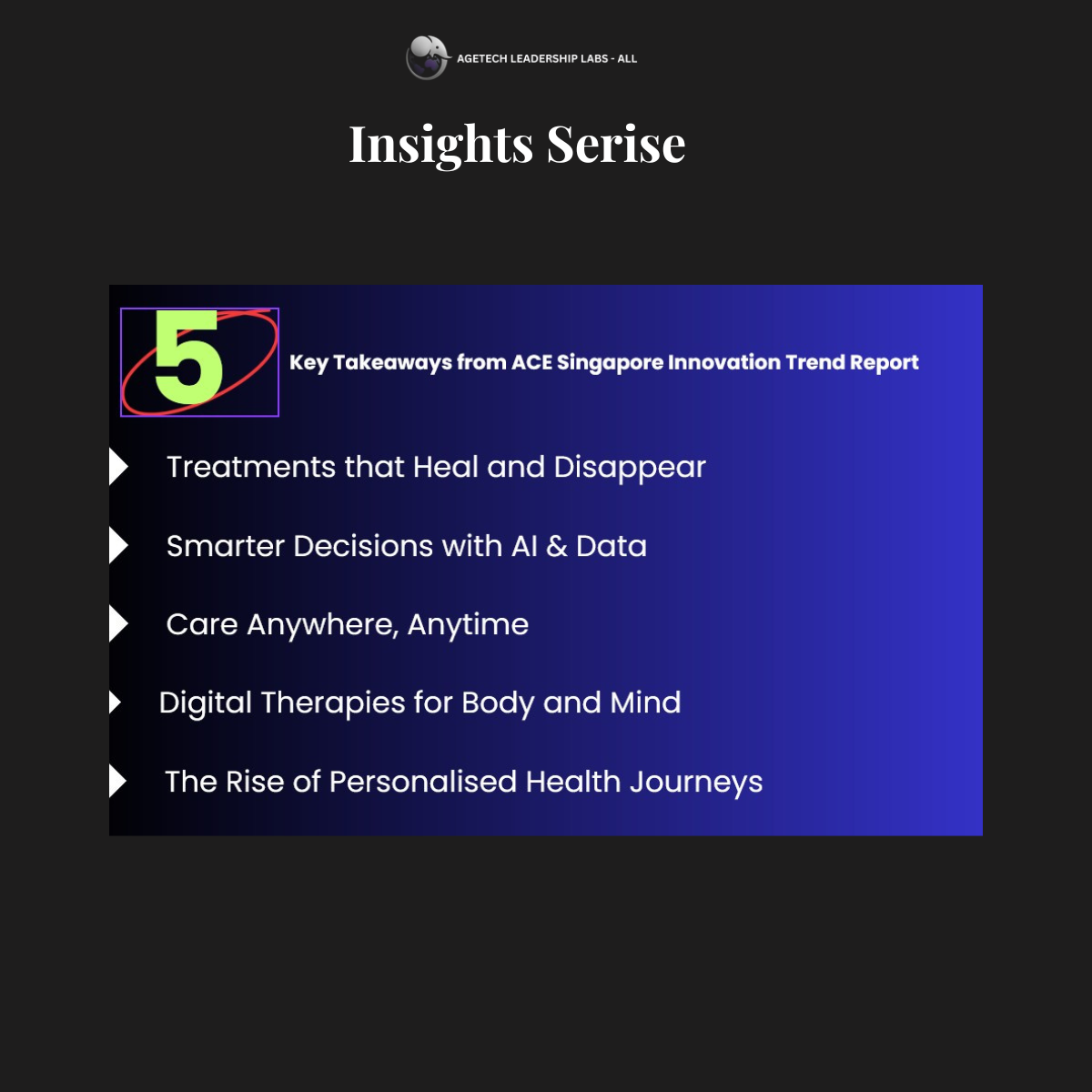
Singapore AEC Key Longevity Economy Treand – 2025
From Innovation to Impact: What Singapore’s ACE Report Means for the Longevity Economy Singapore’s ACE Innovation Trends Report is more than a catalogue of medical technologies; it is a signal that the region is beginning to take the future of ageing and healthcare seriously. By scanning the horizon and highlighting nine areas (which we have compiled into five areas) of breakthrough innovation, ACE has set the stage for how healthcare systems, policymakers, and businesses can prepare for what’s next. Led by Dr. Fereen Liew , the Agency for Care Effectiveness (ACE) has produced one of the first serious attempts to map technologies that could reshape care in the next five years. Where ACE charts the clinical and technological frontier, AgeTech Leadership Labs (ALL) works on the frameworks that help these advances connect and scale. Read together, they tell a powerful story: innovation is accelerating, but its actual impact depends on how well the pieces are stitched into a coherent whole. Here are five big takeaways and why they matter for the future of ageing and longevity. 1. Treatments that Heal and Disappear Imagine an implant that dissolves once it has done its job. Or a surgical procedure that leaves only a pin-sized scar and lets you go home the next day. That is the promise of bioresorbable implants and minimally invasive interventions. This philosophy is already evident in innovations such as CavaClear ( Philips a system for safe filter retrieval) or smaller, robotics-assisted surgeries. The principle is simple: technology should solve problems without leaving new ones behind. Every time recovery is faster and follow-up procedures are avoided, patients regain dignity and systems save resources. Less trauma, less burden and more healing. 2. Smarter Decisions with AI & Data The report highlights how artificial intelligence can assist doctors in diagnosing and treating patients. Pair that with blood-based biomarkers that detect disease earlier and wearables that track health continuously, and a clear theme emerges: healthcare is shifting from a reactive to a proactive approach. Concrete examples already on ACE’s radar include EchoGo Heart Failure (an AI-supported diagnosis), KidneyIntelX (diabetic kidney disease risk scoring), and Canvas Dx ( Cognoa support for autism diagnosis). For patients, that means fewer surprises, earlier interventions, and more personalised insights. For systems, it means moving from firefighting illness to anticipating and preventing it. Data, intelligently used, is becoming the new stethoscope. 3. Care Anywhere, Anytime Not all care needs a hospital bed. With contactless monitoring, sensors can track patients’ vital signs without physical contact. With point-of-care testing, a rapid diagnostic test can deliver lab-quality results at the bedside or in a community clinic. ACE’s horizon scanning highlights Oxevision, a contactless monitoring system used in mental health wards, as well as rapid diagnostics that are already being piloted in community care. This shift decentralises healthcare. It makes access quicker, more convenient, and more affordable. In an ageing society, where demand is expected to grow, bringing care closer to people isn’t a luxury; it’s a necessity. 4. Digital Therapies for Body and Mind What if the treatment for your condition wasn’t a pill, but an app? Digital therapeutics are making that a reality, offering evidence-based programs for the management of chronic diseases or mental health issues. Add virtual and augmented reality into the mix, and rehabilitation becomes interactive, immersive, even game-like. Examples like Relie VRx ( AppliedVR a VR-based therapy for chronic back pain) demonstrate how software is becoming a form of medicine. This is not science fiction. It is a reimagining of care delivery, where digital tools are as important as drugs or devices. The potential is especially powerful for older adults, for whom mental resilience and sustained engagement are as important as physical recovery. 5. The Rise of Personalised Health Journeys The most important theme running through all these trends is personalisation. From wearables that nudge healthier habits to AI tools tailoring treatment plans and apps delivering therapy on demand, healthcare is shifting from one-size-fits-all to what fits me. This matters because ageing is not a uniform process. Two people at 65 may have vastly different health, wealth, and purpose profiles. Systems that recognise and adapt to that diversity will be the ones that succeed in the Longevity Era. Why This Matters for the Longevity Economy If ageing is viewed only through the narrow lens of healthcare, societies will always be reacting to crises. Seen through the lens of the Longevity Economy, however, the opportunity is far greater: building systems that align not just lifespan, but also health, wealth, and purpose. The ACE Innovation Trends Report is a welcome sign that Singapore and Asia more broadly are beginning to think ahead. The challenge now is to ensure these innovations add up to more than the sum of their parts. That is how we turn the “silver elephant” in the room into one of the most significant economic and social opportunities of our time. At AgeTech Leadership Labs (ALL), we see ageing not as a burden but as an asset. The task is not simply to add years to life, but to integrate lifespan, healthspan, wealthspan, and purposespan into systems that serve people, families, and societies. That is the essence of the Longevity Economy. This is why Singapore’s ACE Innovation Trends Report excites us. ACE maps the technologies of tomorrow; ALL works on the frameworks that allow those technologies to connect, scale, and create lasting impact. Together, they point toward a future where innovation in ageing truly redefines longevity. “The silver elephant is here. Let’s turn it into an opportunity. Follow AgeTech Leadership Labs AgeTech Leadership Labs on LinkedIn and visit the website Nitin Jaiswal

The Longevity Economy Blindspot: The Retirement Paradox
In ancient Rome, soldiers did not simply walk away from service; they retired with honor. After 20 years of duty, legionaries were rewarded with land or a payout from the Aerarium Militare, a treasury created by Augustus. These early pensions weren’t just financial support they represented dignity, recognition of loyalty, and the state’s responsibility toward its citizens. Today, that sense of dignity is slipping away. For many, retirement is no longer a moment of relief but a calculation of risk. Will my savings last? What if I live longer than expected? Will the system still be there when I need it? This is the Retirement Paradox: humanity has engineered the gift of longer life, yet the very systems designed to sustain those lives were built for shorter ones. We are living longer than ever before, but financially less prepared than generations who lived shorter lives. A Promise Built on Political Foundations: Retirement was never designed as a universal right. In 1881, German Chancellor Otto von Bismarck introduced the first state pension scheme set at age 70, when life expectancy was 50. Few lived to collect. When Franklin D. Roosevelt created Social Security in 1935, retirement age was set at 65 while the average American man lived only to 61. Post-war Britain and Europe followed the same pattern. These systems were never intended to fund decades of retirement; they were built on the assumption that most people would not live long after leaving the workforce. That assumption no longer holds. The Longevity Revolution and Its Blind Spot: The 20th century delivered humanity’s greatest achievement: longer lives. In 1950, global life expectancy was 46. Today it is 73. In Japan it is 85, and a child born in the U.S. in 2024 may live into their late 80s. We have added decades of life in less than a century. But the wealth to support those years has not kept pace. Pension, healthcare, and housing systems remain anchored in a world of shorter lives. As the OECD’s Pensions at a Glance report notes, most pension systems were designed when lifespans were shorter, and are now under severe strain as people live decades longer. At first glance, the global pension system looks strong, with assets of $76 trillion worldwide. Yet beneath the scale lie outdated assumptions: careers lasting 30–40 years, returns of 7% annually, and retirements of just a decade or two. The reality is shorter, more mobile careers, weaker returns, and retirements that often stretch over 30 years. The $400 Trillion Gap: According to the World Economic Forum, the world faces a $400 trillion retirement savings shortfall by 2050 more than four times today’s global GDP. The U.S. alone accounts for $137 trillion. The drivers are well known. Longevity risk means retirees now live 20–25 years after leaving work, consuming far more than systems were designed to cover. Market under performance has eroded expected returns: bonds yield close to zero, while balanced portfolios struggle to reach 4–5% annually. And inadequate contributions are widespread. In the U.S., the median 401(k) balance for people aged 55–64 is just $185,000 translating to roughly $740 a month in retirement. This is the paradox compounded: longer lives, lower returns, and weaker savings. Cracks Beneath the Surface: Even with trillions under management, pension systems face structural pressures money alone cannot solve. Populations are ageing, creating liquidity strain as more retirees draw down while fewer workers contribute. Promises made decades into the future are funded by assets vulnerable to inflation and interest-rate shifts. And fragmented, employer-based systems fail to support mobile workers, freelancers, and migrants, the fastest-growing segments of today’s workforce. The consequences extend beyond individual hardship. Economies will slow as retirees spend less and governments borrow more. Social stability will fray as pension protests and political unrest grow louder. And inter generational trust may collapse as younger workers pay more for benefits they doubt they will ever receive. As Nobel laureate Joseph Stiglitz reminds us: “A good society invests in the future, not just in the present.” That principle is now at risk. A paradox unaddressed does not remain static; it compounds into crisis. Rethinking Retirement Before It’s Too Late: Addressing the crisis requires more than financial engineering. It calls for a re-imagining of the social contract between workers, employers, and governments. One powerful lever is extending productive lives not forcing full-time work into one’s 70s, but creating flexible transitions: phased retirement, part-time work, and portfolio careers. Retirement must evolve from a cliff edge into a continuum. Another is improving portability and coverage so that every worker, whether gig, migrant, or part-time, has access to pension security. Above all, reform demands political courage. Pension systems are deeply tied to national identity, but delay only raises the cost of change. Some countries are experimenting with solutions: linking retirement ages to life expectancy, raising contribution rates, expanding access to informal workers, or exploring longevity-linked assets. These are important steps, but piecemeal reforms will not close a $400 trillion gap. Historian Peter Laslett once described this period as “the third age – an unprecedented stage of active life after retirement.” His insight underlines why retirement must be re-imagined as contribution and purpose, not decline. The paradox remains stark: our greatest triumph – longer lives is colliding with one of our greatest blind spots outdated financial systems. Unless we act, the gift of longevity could curdle into the dark side of longevity. Retirement must be re imagined not as the end of work, but as a new stage of contribution, purpose, and dignity. Without urgent reform, the Retirement Paradox will harden into a global reckoning measured not just in trillions of dollars, but in broken promises to generations who trusted the system to be there when they needed it most. All about ALL – The Retirement Paradox is just one of many blind spots shaping the future of ageing and finance. At AgeTech Leadership Labs (ALL), we are dedicated to shining a light on these overlooked challenges and building frameworks, standards, and
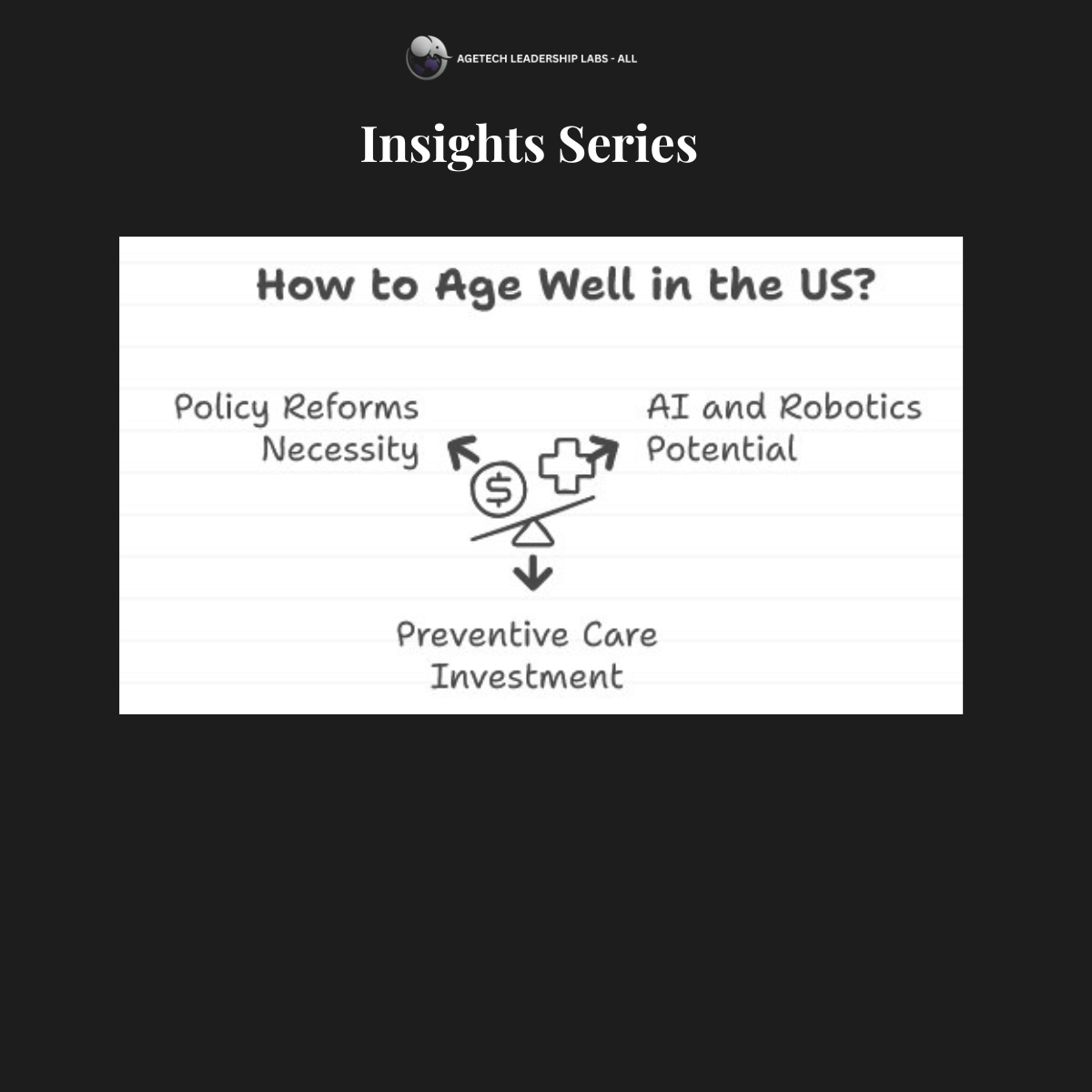
America’s Longevity Paradox: Big Spending, Poor Outcomes. Why Isn’t America Ageing Well?
Last week, I introduced the idea of the Longevity Inflation Index (LII), a new metric for understanding the real impact of rising costs on the savings and security of an ageing population. This week, let’s bring the concept to life with an example that highlights why the traditional Consumer Price Index (CPI) doesn’t tell the full story for older adults and why the LII offers a clearer picture of long-term financial well-being. The American Healthy Ageing Paradox: The United States leads the world in healthcare innovation, with the National Institutes of Health (NIH) investing $48 billion in medical research in 2023—more than any other country. The U.S. devotes 17% of GDP to healthcare and spends $12,700 per capita—over double what Germany spends. With 35% of Americans now over age 50, the country should, in theory, be the global benchmark for healthy ageing. Yet the data paints a starkly different picture: The U.S. ranks 35th in health outcomes globally and last among G7 nations in life expectancy (77.2 years). It has the highest obesity rate (42%) among peer countries, with 13% of Americans diagnosed with diabetes. Cancer incidence: 350 cases per 100,000 people—significantly higher than in other developed nations. Reason for the Paradox – why is the U.S. not ageing well despite its innovation and spending? As Neal K. Shah whom I follow for valuable insights on the Longevity Economy, raised this important question in one of his earlier LinkedIn posts: “Is Soaring Healthcare Inflation the Wake-up Call We Need for A.I. Innovation?” In it, he highlights what he calls ‘Chart of the Century‘ by Mark Perry from the American Enterprise Institute. The chart reveals that healthcare costs (a key part of the Longevity Economy framework) have outpaced inflation across all other sectors over the last 20 years. Despite technological breakthroughs, healthcare remains stubbornly expensive, making innovation feel out of reach for many and emphasising the urgent need for disruptive change. In just 24 years, U.S. healthcare costs have climbed over 200%, catapulting health insurance to the second-largest expense after payroll for many employers. At the same time, these trends strain not only the U.S. but also other advanced economies worldwide, threatening their long-term economic sustainability. The Longevity Inflation Index will shed light on this paradox. The Pressure of Paradox: With an ageing population, fewer working-age adults, shrinking fiscal resources, and eroding public services, the U.S. is at a tipping point. If bold reforms are not enacted, such as shifting priorities toward prevention and smarter fiscal policy, the gap between investment and outcomes will continue to widen. The concerns of America’s ageing population are real, as visualised in the chart below. How to move from Paradox to Perfection? Policy makers, healthcare leaders, and innovators must focus on turning technological possibilities into widespread benefits. AgeTech Leadership Labs advises proactive policies, systemic reforms, and fiscal discipline. Key among them includes: 1. Focus on the “AAA” standard for healthspan: The policy framework should ensure Affordable: Ensure Innovation in treatments doesn’t remain a luxury for the wealthy. Available: Expand access across geographies and demographics. Accessible: Remove barriers so older adults can truly benefit from innovation. 2. Focus on Prevention: At a systemic level, a fundamental rebalancing toward prevention, not just treatment, is critical. Even with substantial spending, the U.S. system continues to favour late-stage medical intervention over wellness and disease prevention. Prioritising prevention could dramatically lower long-term costs and improve health outcomes. 3. Technology as Lifeline: Technology offers promise, but must be paired with policy and prevention to deliver real results. AI and robotics provide real hope for the $4 trillion healthcare sector: As futurist Ray Kurzweil suggested, AI can streamline care delivery, enhance diagnostics, and reduce administrative overhead. Robotics, spearheaded by leaders like Elon Musk, offer the potential for personalised, affordable care companions – especially important for underserved communities. The Moment for Decisive Leadership: The stakes could not be higher: The future of healthcare will profoundly shape America’s competitiveness, well-being, and social fabric. To avoid deepening the paradox, the U.S. must ensure health benefits and innovation are genuinely Affordable, Available, and Accessible for all. Will America rise to the challenge, or continue down an unsustainable path? The time for action is now. Follow AgeTech Leadership Labs page to get insights on the development of the global Longevity Economy Framework and Longevity Inflation Index #LongevityInflation #HealthyAging #ChartOfTheCentury #HealthcareInnovation #AgingWell #PreventionFirst #LongevityEconomy

Longevity Inflation: Exposing the Economic Blind Spot of Extended Lifespans
As we step deeper into the era of 100-year lives, the global economy is confronting a silent crisis: traditional inflation frameworks are dangerously outdated. Built around mid-life spending patterns, the Consumer Price Index (CPI) underestimates the financial reality of aging, masking the escalating costs of extended longevity and putting individuals, institutions, and governments at risk. This economic oversight Longevity Inflation is poised to become one of the most profound fiscal challenges of the coming decades. The Longevity Economy, driven by individuals aged 50 and older, is already contributing over $8.3 trillion annually to global GDP. Yet inflation metrics built for a world of shorter life expectancy leave a dangerous planning gap. Our current CPI framework fails to reflect healthcare, caregiving, and technological costs that surge exponentially in the final decades of life, a phenomenon described as the “J-curve” of Longevity Inflation. Enter the ALL Longevity Inflation IndexTo address this blind spot, we introduce the Aging-Linked Lifestyle (ALL) Inflation Index, an innovative, age-adjusted framework that resists traditional linear inflation assumptions. The ALL Index is structurally designed to track the unique cost trajectory of an extended lifespan, particularly in the context of rising medical needs, digital health technologies, caregiver wage inflation, and housing modifications for aging in place. Backed by demographic data, the ALL Index reflects how older adults spend significantly more on healthcare (26% of budgets vs. CPI’s 8.8%) and caregiving, often with no representation in standard indices. Our model estimates that longevity-driven costs outpace CPI by 1.5% to 3.1% annually, compounding into substantial wealth and planning gaps; a $1 trillion global retirement income shortfall by 2040 is now within sight. Visualizing the J-Curve: Cost Acceleration With AgeWhile CPI estimates aging costs to climb modestly through retirement, the reality is starkly different. For instance, costs at age 85 can spike more than 100% above CPI-based projections, driven by long-term care, home health aides, AgeTech, and advanced diagnostics. The curve of spending flattens early but spikes rapidly as dependency increases and traditional metrics fail to capture this inflection point. In the U.S. alone, projected healthcare spending for those aged 85+ will escalate sharply over the next two decades, compounding the retirement income gap. Our ALL Index model, which reweights categories for aging adults and includes longevity-specific expenditures, projects inflation divergence reaching nearly 2.7% by the 2040s. Why the CPI Fails and Why It MattersThe CPI was never designed for octogenarians. It was constructed in the early 20th century to track general spending for wage-earners, with limited healthcare weighting and zero inclusion of informal caregiving, home modifications, or digital aging technologies. The result? Most financial plans are built around flawed assumptions. For example, a retired individual with $1.2M saved, expected 2.5% CPI inflation. But by age 80, her real expenses had inflated at 4.5% annually, driven by caregiving, health monitoring, and accessibility renovations. Under CPI, her funds were projected to last until age 90 under real longevity-adjusted inflation; they depleted by 85. Sectoral Impact: From Planning to PolicyThe implications of Longevity Inflation ripple across every sector:– Financial planners must integrate the ALL Index to prevent underfunding and guide clients toward longevity-linked investment strategies.– Insurers must stress-test annuity products and long-term care offerings for inflation mismatches.– Policymakers should consider indexing retirement benefits and public subsidies to the ALL framework instead of CPI.– AgeTech providers and real estate developers have an opportunity and obligation to help moderate the rising J-curve through innovation and infrastructure. A Call to Action: Collectively Reshaping the Longevity EconomyWithout reform, the Longevity Economy could turn from a $8.3 trillion engine of value into a liability of crisis proportions. The economic blind spot of Longevity Inflation demands urgent correction. Let’s future-proof our financial systems for the 100-year life. Not just for Maria. For all of us. An Abstract from My Forthcoming Book “Silver Elephant”

Compounding Longevity and Climate Crisis
As part of my research on the “Longevity Economy,” I’ve been reading the thought-provoking book Lifespan by David A. Sinclair A.O., Ph.D. Professor at Harvard Medical School. Two concepts he presents about longevity in the book are particularly profound and worth contemplating. 1: Compounding Longevity: Dr. Sinclair highlights that for every month you manage to stay alive, advancements in medical technology add another week to your life. I call this phenomenon “Compounding Longevity”. Think about it. We often get excited about the impact of compounding on our investments. What Dr. Sinclair suggests is essentially the compounding of our lifespan due to breakthroughs in medical science. He further elaborates: “Forty years from now, it could be another two weeks. Eighty years from now, another three. Things could get really interesting by the end of the century if, for every month you are alive, you gain another four weeks.” If we take his argument to heart, it means that investing in a healthy lifestyle now will have a significant payoff in the future. Unfortunately, discussions about the latest medical advancements are often overshadowed by trends like crypto and blockchain, which, while important, don’t contribute to our longevity. Just as we have Systematic Investment Plans (SIPs) for our financial future, I suggest we need a Systematic Healthy Investment Plan (SHIP) to ensure we live long enough to enjoy the fruits of those financial plans. The time to let this SHIP sail is now. 2: The Longevity Dilemma and Environmental Impact: Dr. Sinclair also points out that Jeanne Calment, who holds the record for the longest lifespan of any person, may soon lose her spot among the top ten oldest humans as medical technology continues to evolve. He writes: “What if people who have lived beyond 110 had access to all the new technologies? Could they have made it to 120 or 130? Perhaps.” But what if humans start living to 120 or 130 years? While it may seem like a remarkable achievement, it could have devastating consequences for our environment. As Sinclair writes: “The problem is not population, but its consumption. And it’s not consumption alone, it’s waste. In comes the food; out goes the effluent. In comes the fossil fuel; out goes the carbon emissions.” With our current patterns of consumption and waste generation, increased longevity could become a curse for the planet. In a public policy class at Harvard, we explored counterfactuals, such as: What if the world adopted the consumption habits of Americans? The results would be catastrophic. According to Sinclair: “On average, Americans consume more than three times the amount of food they need to survive and about 250 times as much water. In return, they produce 4.4 pounds of trash each day. The annual carbon dioxide emission of an average American is five times as high as the global average.” He then poses a critical question: What if everyone in the world consumed as Americans do for just one year? According to the nonprofit Global Footprint Network, it would take the Earth four years to regenerate the resources consumed and absorb the waste produced in that single year. This is textbook unsustainability: We consume, consume, consume, and return very little of value to our natural world. A Call to Action Humans must recognize that medical advancements will extend life, though the exact extent remains uncertain. What we do know is that this longevity will be significant. At the same time, we must acknowledge that Earth is currently the only home we have. If we do not change our behavior around consumption and waste, as Dr. Sinclair warns, “as we live longer, these environmental crises will be exacerbated.” At some point, we may reach the point of no return. The time to recognize and act is now.

Introducing Gen-E, the Natives of the 8th Continent Longevity Economy
“The way we see the problem is the problem itself.” Stephen R. Covey. This timeless insight applies directly to how we view the 50+ demographic today. For too long, societies have labeled this group as an “aging population,” defining them by physical traits like silver hair or the notion of retirement. This outdated perspective treats them as a liability, tethering them to a narrow and limiting framework. But the real issue lies in how we define aging itself. As we all age from the moment we’re born, what makes 50 a milestone that defines an entire population? Age is not a static number it’s a continuous journey. So why are we still using outdated labels like “Silver Generation” to describe people over 50? At AgeTech Leadership Labs (ALL), we’ve coined Gen E – Generation Evolve, Empower, and Experience to redefine what it means to be over 50. Gen E is not about silver hair or the end of one’s career. It’s about a generation that continues to evolve, contribute, and lead well beyond the traditional retirement age. They are the driving force behind economies, societies, and innovations worldwide. Gen E is not emerging it’s already here, and it’s time we embrace this powerful shift. The Demographic Power of Gen E The numbers speak for themselves. Gen E is one of the most influential and underappreciated demographics of our time. In fact, people over 50 control 70% of household wealth in developed nations and drive 50% of global consumer spending, accounting for a staggering $35 trillion annually. And this figure is only set to grow. By 2050, adults over 50 are projected to contribute $118 trillion to global GDP more than 50% of total global consumption. Moreover, Gen E is adopting new technologies three times faster than millennials in key sectors such as healthcare, fintech, and lifestyle services. Contrary to the outdated belief that older adults are resistant to innovation, Gen E is actually leading the charge in technology adoption, embracing digital tools that enhance their health, finances, and overall quality of life. Shifting the Narrative: Ageing as an Asset, Not a Burden The narrative around older generations has always been framed through the lens of burden: the cost of healthcare, the need for pensions, and the challenges of an ageing society. But this perspective fails to account for the immense potential this demographic holds. “People over 50 are not a burden, they are a massive, untapped resource.” Dr. Joseph Coughlin, MIT AgeLab. As Dr. Coughlin points out, the value Gen E brings to society is far beyond traditional retirement. They represent experience, innovation, and leadership. They are the engines behind some of the world’s most successful startups and serve as key decision-makers in both business and politics. Moreover, 75% of countries worldwide are facing declining fertility rates. This makes longevity not a crisis but a universal economic driver. The Longevity Economy, powered by Gen E, is emerging as one of the most important sectors of global economic growth, yet it is still vastly under-leveraged by governments and businesses. The Global Economic Impact: The $118 Trillion Opportunity The global economic power of Gen E is undeniable. Today, adults over 50 are responsible for over 50% of global consumption and contribute more than $45 trillion to global GDP (AARP, 2020). However, despite these impressive figures, less than 10% of national investment strategies are focused on addressing the needs and tapping into the potential of this group. To put it simply: the world is missing an opportunity of $118 trillion. As David Sinclair, a renowned biologist, says, “The next big economic revolution will be the one driven by longevity, and the people who are leading it will be over 50.” Why Gen E Is Not Just Another ‘Silver Generation’ The term “Silver Generation” and other traditional labels are inherently tied to physical attributes, often implying fragility, decline, and the end of active life. But Gen E is different. Gen E is not a group defined by silver hair or retirement; it’s a group defined by the capacity to evolve, empower, and contribute in profound ways. They are the true assets of this century, possessing the experience, skills, and knowledge that fuel growth and innovation. The Paradigm Shift: Gen E Is the Future The real change is not just about recognizing the financial and social power of Gen E; it’s about changing our perspective on aging itself. Aging is not a problem to be managed, but an opportunity to be embraced. We are living in a world where people are living longer, healthier lives, and Gen E is leading this transformation. This paradigm shift is what will unlock new levels of growth, opportunity, and innovation. By viewing Gen E through a new lens not as a “burden” but as an active, contributing demographic—we can build a Longevity Economy that will define the next era of economic prosperity and social wellbeing. In Conclusion: The shift in how we view and engage with Gen E will have profound implications for economies, societies, and generations to come. The time to act is now embrace Gen E, break free from outdated views, and begin building a future that empowers all generations to thrive. Nitin Jaiswal
